

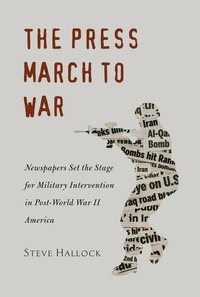
The Press March to War
Newspapers Set the Stage for Military Intervention in Post-World War II America
Will be published approx. on 18. May 2012
Book
Hardback
293 pages
978-1-4331-1376-5 (ISBN)
Description
The 2003 war against Iraq was not the first instance of a president taking the nation into foreign conflict assisted by a submissive Congress and national press corps that did not adequately challenge the case for intervention. All foreign U.S. military action since World War II has been undertaken without the constitutionally required declaration of war, and with the support of the national press corps. Factors behind this press complicity - which is at odds with the traditional press role of watchdog over government policies - include political, economic, and national security ideologies the press shares with administration and government officials - the same sources upon whom the press relies for credible information.
Sending troops to fight in foreign lands is the most difficult, and most important, decision a president can make. Assisting this decision has been a press that, in failing to meet its watchdog responsibility during this key pre-war period, has instead helped construct and maintain a war agenda. With a comprehensive overview of all conflicts from the Korean War to intervention in Libya, this book examines the supportive relationship of press to power in building a conflict rationale during the vital period leading up to combat.
Reviews / Votes
<<Taking the country to war is a decision of the utmost gravity. When we've needed the nation's press to provide an independent institutional voice in guiding public deliberation, they have instead failed to learn from history and worked to sell a policy already in the works. With few exceptions since World War II the pattern has been disturbingly consistent, as Steve Hallock lays it out in this close reading of the editorial evidence.>> (Stephen D. Reese, Jesse H. Jones Professor, College of Communication, University of Texas)<<In this usefully broad sweep across newspaper editorializing on American wars and conflicts in the decades after World War II, Steve Hallock provides an immensely interesting account of the nexus between foreign policy and the opinions of the elite press.>> (Theodore L. Glasser, Stanford University) <<Taking the country to war is a decision of the utmost gravity. When we've needed the nation's press to provide an independent institutional voice in guiding public deliberation, they have instead failed to learn from history and worked to sell a policy already in the works. With few exceptions since World War II the pattern has been disturbingly consistent, as Steve Hallock lays it out in this close reading of the editorial evidence.>> (Stephen D. Reese, Jesse H. Jones Professor, College of Communication, University of Texas)
<<In this usefully broad sweep across newspaper editorializing on American wars and conflicts in the decades after World War II, Steve Hallock provides an immensely interesting account of the nexus between foreign policy and the opinions of the elite press.>> (Theodore L. Glasser, Stanford University)
More details
Other editions
Additional editions
Steve Hallock
The Press March to War
Newspapers Set the Stage for Military Intervention in Post-World War II America
Book
05/2012
Peter Lang Verlag
€41.85
Shipment within 7-9 days
Person
Steve Hallock, Director of the School of Communication at Point Park University, earned his PhD in journalism at Ohio University in 2005 following a nearly 30-year newspaper career. As a newspaper editor, editorial writer, columnist, and reporter, he won numerous national, regional, and state awards for enterprise and investigative reporting and commentary. He has published op-ed commentaries for newspapers that include The New York Times, Philadelphia Inquirer, Pittsburgh Post-Gazette, St. Louis Post-Dispatch, andDenver Post, and he has authored two books, Reporters Who Made History: Great American Journalists on the Issues and Crises of the Late Twentieth Century (2010), and Editorial and Opinion: The Dwindling Marketplace of Ideas in Today's News (2007).