

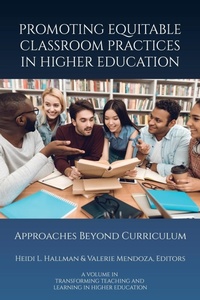
Promoting Equitable Classroom Practices in Higher Education
Approaches Beyond Curriculum
Published on 30. May 2024
Book
Paperback/Softback
220 pages
979-8-88730-619-3 (ISBN)
Description
The current interest in diversity, equity, inclusion, and belonging (DEIB) in higher education emerges from a reality that higher education now serves an increasing diversity of college students. An increasingly diverse student body brings to campuses various backgrounds, linguistic variations, political and religious affiliations, and sexual orientations; therefore, colleges and universities have been prompted to select content, assessment measures, and instructional strategies to not only welcome and support diversity, but to also position students' diverse backgrounds as assets in the classrooms.
This edited volume seeks to put theory into practice by inviting contributions by scholars who aim to transform the higher education classroom through equitable classroom practices premised on culturally sustaining pedagogy. Contributors to the edited volume are faculty in higher education who depict change in instruction that fosters a more inclusive and equitable learning environment. Seeking to create an understanding of how we can more fully humanize our students within historically dehumanizing institutions, we invite readers to consider equitable teaching practices through a variety of lenses. Under the canopy of access, connectedness, and belonging, this volume features initiatives that will hopefully inspire change in higher education.
This edited volume seeks to put theory into practice by inviting contributions by scholars who aim to transform the higher education classroom through equitable classroom practices premised on culturally sustaining pedagogy. Contributors to the edited volume are faculty in higher education who depict change in instruction that fosters a more inclusive and equitable learning environment. Seeking to create an understanding of how we can more fully humanize our students within historically dehumanizing institutions, we invite readers to consider equitable teaching practices through a variety of lenses. Under the canopy of access, connectedness, and belonging, this volume features initiatives that will hopefully inspire change in higher education.
More details
Series
Language
English
Place of publication
United States
Publishing group
Emerald Publishing Inc
Target group
Professional and scholarly
Dimensions
Height: 234 mm
Width: 156 mm
Thickness: 12 mm
Weight
342 gr
ISBN-13
979-8-88730-619-3 (9798887306193)
Copyright in bibliographic data and cover images is held by Nielsen Book Services Limited or by the publishers or by their respective licensors: all rights reserved.
Schweitzer Classification
Other editions
Additional editions

Heidi L. Hallman | Valerie Mendoza
Promoting Equitable Classroom Practices in Higher Education
Approaches Beyond Curriculum
E-Book
06/2024
1st Edition
IAP - Information Age Publishing
€80.60
Available for download
Persons
Content
Editors' Introduction; Heidi L. Hallman and Valerie Mendoza.
Chapter 1. On Integrating Historically White Colleges and Universities: Debates Over Diversity, Equity, Inclusion, and Belonging in Context; Nicholas Mitchell.
Chapter 2. Speculative Design in the Anti-Racist Classroom: Field Notes From Graduate Education in Learning Design; Michelle Ohnona and Ijeoma Njaka.
Chapter 3. Culturally Responsive Computing and Centering Students in Introductory College Computer Science Courses; Marisol Clark-Ibanez, Nery Chapeton-Lamas, Youwen Ouyang, Flor Saldana, and Luke Lara.
Chapter 4. Public Humanities Practices as Fugitive Pedagogies in Latinx Communities From Kansas to New Jersey; William Garcia-Medina.
Chapter 5. Using Labor-Based Grading Contracts and Virtual Platforms to Create Inclusive Teaching Practices; Jessica Jorgenson Borchert.
Chapter 6. Ironic Exclusion: Refocusing the Classroom to Prioritize the Oppressed When Learning About Oppression; Ryan M. Pickering.
Chapter 7. Acknowledging Cultural Differences in the Math Classroom; Angela Crumer.
Chapter 8. Map for Change: Rising up in Support of Undocumented Students; Diana Camilo, Keisha Chin Goosby, Josefina Espino, Karina Duarte, Michelle Ramos-Pellicia, Carolina Valdivia, and Marisol Clark-Ibanez.
Chapter 9. Coalition Building Through Inclusive Pedagogy; Valerie Mendoza.
Chapter 10. Training Faculty in Culturally Sustaining Pedagogy Using Validation Theory; Devan R. Romero, Marisol Clark-Ibanez, Minerva Gonzalez, and Kimberly D'Anna-Hernandez.
Chapter 11. Anti-Racist Semester Endings: (Re) imagining Higher Education Pedagogies; Amaarah DeCuir.
About the Authors.
Chapter 1. On Integrating Historically White Colleges and Universities: Debates Over Diversity, Equity, Inclusion, and Belonging in Context; Nicholas Mitchell.
Chapter 2. Speculative Design in the Anti-Racist Classroom: Field Notes From Graduate Education in Learning Design; Michelle Ohnona and Ijeoma Njaka.
Chapter 3. Culturally Responsive Computing and Centering Students in Introductory College Computer Science Courses; Marisol Clark-Ibanez, Nery Chapeton-Lamas, Youwen Ouyang, Flor Saldana, and Luke Lara.
Chapter 4. Public Humanities Practices as Fugitive Pedagogies in Latinx Communities From Kansas to New Jersey; William Garcia-Medina.
Chapter 5. Using Labor-Based Grading Contracts and Virtual Platforms to Create Inclusive Teaching Practices; Jessica Jorgenson Borchert.
Chapter 6. Ironic Exclusion: Refocusing the Classroom to Prioritize the Oppressed When Learning About Oppression; Ryan M. Pickering.
Chapter 7. Acknowledging Cultural Differences in the Math Classroom; Angela Crumer.
Chapter 8. Map for Change: Rising up in Support of Undocumented Students; Diana Camilo, Keisha Chin Goosby, Josefina Espino, Karina Duarte, Michelle Ramos-Pellicia, Carolina Valdivia, and Marisol Clark-Ibanez.
Chapter 9. Coalition Building Through Inclusive Pedagogy; Valerie Mendoza.
Chapter 10. Training Faculty in Culturally Sustaining Pedagogy Using Validation Theory; Devan R. Romero, Marisol Clark-Ibanez, Minerva Gonzalez, and Kimberly D'Anna-Hernandez.
Chapter 11. Anti-Racist Semester Endings: (Re) imagining Higher Education Pedagogies; Amaarah DeCuir.
About the Authors.