

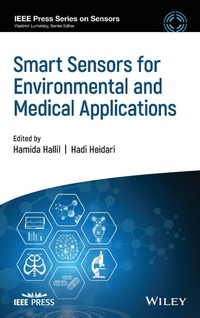
Smart Sensors for Environmental and Medical Applications
1st Edition
Published on 28. February 2020
Book
Hardback
220 pages
978-1-119-58734-7 (ISBN)
Description
Provides an introduction to the topic of smart chemical sensors, along with an overview of the state of the art based on potential applications
This book presents a comprehensive overview of chemical sensors, ranging from the choice of material to sensor validation, modeling, simulation, and manufacturing. It discusses the process of data collection by intelligent techniques such as deep learning, multivariate analysis, and others. It also incorporates different types of smart chemical sensors and discusses each under a common set of sub-sections so that readers can fully understand the advantages and disadvantages of the relevant transducers--depending on the design, transduction mode, and final applications.
Smart Sensors for Environmental and Medical Applications covers all major aspects of the field of smart chemical sensors, including working principle and related theory, sensor materials, classification of respective transducer type, relevant fabrication processes, methods for data analysis, and suitable applications. Chapters address field effect transistors technologies for biological and chemical sensors, mammalian cell-based electrochemical sensors for label-free monitoring of analytes, electronic tongues, chemical sensors based on metal oxides, metal oxide (MOX) gas sensor electronic interfaces, and more.
Addressing the limitations and challenges in obtaining state-of-the-art smart biochemical sensors, this book:
* Balances the fundamentals of sensor design, fabrication, characterization, and analysis with advanced methods
* Categorizes sensors into sub-types and describes their working, focusing on prominent applications
* Describes instrumentation and IoT networking methods of chemical transducers that can be used for inexpensive, accurate detection in commercialized smart chemical sensors
* Covers monitoring of food spoilage using polydiacetylene- and liposome-based sensors; smart and intelligent E-nose for sensitive and selective chemical sensing applications; odor sensing system; and microwave chemical sensors
Smart Sensors for Environmental and Medical Applications is an important book for senior-level undergraduate and graduate students learning about this high-performance technology and its many applications. It will also inform practitioners and researchers involved in the creation and use of smart sensors.
This book presents a comprehensive overview of chemical sensors, ranging from the choice of material to sensor validation, modeling, simulation, and manufacturing. It discusses the process of data collection by intelligent techniques such as deep learning, multivariate analysis, and others. It also incorporates different types of smart chemical sensors and discusses each under a common set of sub-sections so that readers can fully understand the advantages and disadvantages of the relevant transducers--depending on the design, transduction mode, and final applications.
Smart Sensors for Environmental and Medical Applications covers all major aspects of the field of smart chemical sensors, including working principle and related theory, sensor materials, classification of respective transducer type, relevant fabrication processes, methods for data analysis, and suitable applications. Chapters address field effect transistors technologies for biological and chemical sensors, mammalian cell-based electrochemical sensors for label-free monitoring of analytes, electronic tongues, chemical sensors based on metal oxides, metal oxide (MOX) gas sensor electronic interfaces, and more.
Addressing the limitations and challenges in obtaining state-of-the-art smart biochemical sensors, this book:
* Balances the fundamentals of sensor design, fabrication, characterization, and analysis with advanced methods
* Categorizes sensors into sub-types and describes their working, focusing on prominent applications
* Describes instrumentation and IoT networking methods of chemical transducers that can be used for inexpensive, accurate detection in commercialized smart chemical sensors
* Covers monitoring of food spoilage using polydiacetylene- and liposome-based sensors; smart and intelligent E-nose for sensitive and selective chemical sensing applications; odor sensing system; and microwave chemical sensors
Smart Sensors for Environmental and Medical Applications is an important book for senior-level undergraduate and graduate students learning about this high-performance technology and its many applications. It will also inform practitioners and researchers involved in the creation and use of smart sensors.
More details
Other editions
Additional editions
Hamida Hallil | Hadi Heidari
Smart Sensors for Environmental and Medical Applications
E-Book
06/2020
1st Edition
Wiley
€116.99
Available for download
Hamida Hallil | Hadi Heidari
Smart Sensors for Environmental and Medical Applications
E-Book
04/2020
1st Edition
Wiley
€116.99
Available for download
Persons
Hamida Hallil, PhD, is an Associate Professor at the IMS Laboratory (UMR CNRS 5218), University of Bordeaux. She has been involved in several national and international research projects, including the Merlion PHC and CAMUS projects and the Bordeaux University project. Professor Hallil also served on the organizing or technical committees of several conferences, including IEEE SENSORS '16 and '17, DTIP '17 and '18, and IEEE NMDC '17 and '18.
Hadi Heidari, PhD, is a Lecturer in the School of Engineering at the University of Glasgow. He is a senior member of the IEEE and has served as member of the IEEE Circuits and Systems Society Board of Governors (BoG) and the IEEE Sensors Council Administrative Committee (AdCom). Professor Heidari has served on the organizing committee of several conferences, including IEEE SENSORS '16 and '17, NGCAS '17, BioCAS'18, and PRIME '15. He is also a co-author of Magnetic Sensors for Biomedical Applications (Wiley-IEEE Press).
Hadi Heidari, PhD, is a Lecturer in the School of Engineering at the University of Glasgow. He is a senior member of the IEEE and has served as member of the IEEE Circuits and Systems Society Board of Governors (BoG) and the IEEE Sensors Council Administrative Committee (AdCom). Professor Heidari has served on the organizing committee of several conferences, including IEEE SENSORS '16 and '17, NGCAS '17, BioCAS'18, and PRIME '15. He is also a co-author of Magnetic Sensors for Biomedical Applications (Wiley-IEEE Press).