

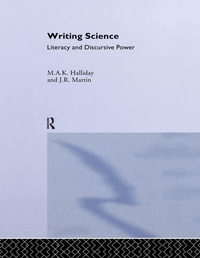
Writing Science
Literacy And Discursive Power
1st Edition
Published on 21. December 2015
Book
Paperback/Softback
300 pages
978-1-138-99758-5 (ISBN)
Description
This book is about the use of language in the science classroom. It discusses the evolution of scientific discourse for learning in secondary schools, and examines the form and function of language across a variety of levels including lexiogrammar, discourse semantics, register, genre and ideology. Special attention is paid to how this knowledge is imparted. It will be of particular interest to educators involved with linguistics and/or science curriculum and teachers of English for special and academic purposes.; It is aimed at teachers of undergraduates in science and literacy, linguists teaching in English for special and academic purposes and students in higher education with an interest in science and literacy.
More details
Language
English
Place of publication
London
United Kingdom
Publishing group
Taylor & Francis Ltd
Target group
Professional and scholarly
Professional Practice & Development
Dimensions
Height: 280 mm
Width: 216 mm
Thickness: 16 mm
Weight
760 gr
ISBN-13
978-1-138-99758-5 (9781138997585)
Copyright in bibliographic data and cover images is held by Nielsen Book Services Limited or by the publishers or by their respective licensors: all rights reserved.
Schweitzer Classification
Other editions
Additional editions
E-Book
09/2003
1st Edition
Routledge
€65.99
Available for download
E-Book
09/2003
1st Edition
Routledge
€65.99
Available for download
Book
05/1993
1st Edition
Routledge Falmer
€252.40
Article not available for order
Persons
M.A.K Halliday, J.R. Martin
Content
Introduction - the discursive technology of science. Part 1 Professional literacy: construing nature; on the language of physical science; some grammatical problems in scientific English; the construction of knowledge and value of the grammar of scientific discourse - with reference to Charles Darwin's The Origin of the Species; language and the order of nature; the analysis of scientific texts in English and Chinese. Part 2 School literacy: construing knowledge. Part 3 Uncommon sense: secondary geography and science; the discourse of geography - ordering and explaining the experimental world; literacy in science - learning to handle text as technology. Part 4 Technicality and abstraction: secondary science and humanities; technicality and abstraction - language for the creation of specialised texts; secret English - discourse technology in a junior secondary school; life as a noun - arresting the universe in science and technology.