

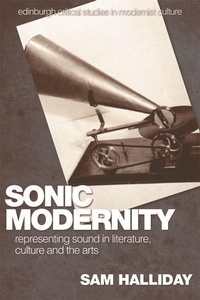
Sonic Modernity
Representing Sound in Literature, Culture and the Arts
Published on 14. March 2013
Book
Hardback
224 pages
978-0-7486-2761-5 (ISBN)
Description
In this thoughtful and engaging study, Sam Halliday reveals the many roles and forms of sound in modernism.
Drawing on a wealth of texts and thinkers, the book shows the distinctive nature of sonic cultures in modernity. Arguing that these cultures are not reducible to sound alone, the book further shows that these encompass representations of sound in 'other' media: especially literature; but also, cinema and painting.
Figures discussed include canonical writers such as Joyce, Richardson, and Woolf; relatively neglected writers such as Henry Roth and Bryher; and a whole host of musicians, artists, and other commentators, including Wagner, Schoenberg, Kandinsky, Adorno, and Benjamin. Conceptually as well as topically diverse, the book engages issues such as city noise and 'foreign' accents, representations of sound in 'silent' cinema, the relationship of music to language, and the effects of technology on sonic production and reception.
Drawing on a wealth of texts and thinkers, the book shows the distinctive nature of sonic cultures in modernity. Arguing that these cultures are not reducible to sound alone, the book further shows that these encompass representations of sound in 'other' media: especially literature; but also, cinema and painting.
Figures discussed include canonical writers such as Joyce, Richardson, and Woolf; relatively neglected writers such as Henry Roth and Bryher; and a whole host of musicians, artists, and other commentators, including Wagner, Schoenberg, Kandinsky, Adorno, and Benjamin. Conceptually as well as topically diverse, the book engages issues such as city noise and 'foreign' accents, representations of sound in 'silent' cinema, the relationship of music to language, and the effects of technology on sonic production and reception.
Reviews / Votes
... a truly impressive and interdisciplinary overview of the subject. -- CHRISTIN HOENE, Humboldt University of Berlin * Music and Letters, vol 17, no 2 * Sam Halliday's fascinating account of sonic modernity offers a distinctively new terrain for modernist studies. Wide-ranging and superbly well-informed, his book will make attentive listeners of us all. * Peter Nicholls, Professor of English, New York University * One of the most exciting accounts of modernism to have appeared for some time, Sonic Modernity is a vibrant panorama of a book, underwritten with a powerful conceptual sensibility. Addressing a wide array of writers, composers, and other figures, this study offers a refreshed and wholly original inquiry into the unexpected reaches of modernist ideas. * Professor Ian F. A. Bell, Keele University * Conceptually expansive and revealingly oxymoronic, Sam Halliday's exploration of the effect of technological development on modernism's relationship with sound is thorough and illuminating. -- Serena Gosden * TLS *More details
Series
Language
English
Place of publication
Edinburgh
United Kingdom
Target group
Professional and scholarly
Product notice
sewn/stitched
Cloth over boards
Dimensions
Height: 236 mm
Width: 157 mm
Thickness: 18 mm
Weight
476 gr
ISBN-13
978-0-7486-2761-5 (9780748627615)
Copyright in bibliographic data and cover images is held by Nielsen Book Services Limited or by the publishers or by their respective licensors: all rights reserved.
Schweitzer Classification
Other editions
Additional editions
E-Book
03/2013
Edinburgh University Press
€0.00
Available for download
Person
Sam Halliday teaches in the Department of English at Queen Mary, University of London. He is the author of Science and Technology in the Age of Hawthorne, Melville, Twain, and James: Thinking and Writing Electricity (2007).
Content
List of Illustrations; Acknowledgements; Introduction: the Sonic Cultures of Modernity; Overture: L'Inhumaine; The Ear in History: Some Theory; Representing Sound in Literature; Defining "Modern" Sound; Or, Marvin Gaye as Theorist of Modernity; Chapter One. Theorising Sound and Hearing; Sound in Philosophy from Aristotle to Marx; Darwin, Kant (again), and Physiology; Technology, and the Dialectic of Sensory Excitement and Exhaustion; Sound in Literary Modernism; Music Amongst the Other Arts; Music, Language, and Meaning; Chapter Two. Sound and Social Life; Dorothy Richardson and Sound-space; Music as Paradigm of Sociality; Parties, City Streets, and Foreign Accents; Telephones, Radio and Gramophones; Love and the Piano; Wagner at Bayreuth; Chapter Three. Seeing Sound; Substitution and the Word; Substitution and the Image; Inter-art Translation or Equivalence; Light and Colour; Psychiatry, and 'Neuro-grammatology'; On Musical Notation; Chapter Four. Modernising Music; Historicity and Dissonance; Pitch division, Rhythmic Chords, and Synthesizers; Precision and Preservation; The 'phonograph effect', and Jazz; Jazz and the Extra-Musical, and Blues; Coda: musical (un)timeliness; Chapter Five. The Art of Listening; Listening and/as Attention; Memory and Silence; Against the 'Talkie'; Blindness and Cathected Space; Coda: Listening as Life; Bibliography; Index.