

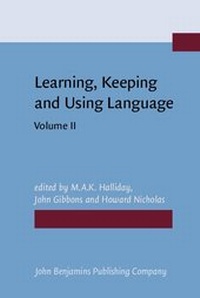
Learning, Keeping and Using Language
Selected papers from the Eighth World Congress of Applied Linguistics, Sydney, 16-21 August 1987. Volume 2
Published on 1. January 1990
Book
Hardback
488 pages
978-1-55619-105-3 (ISBN)
Description
This volume contains selected papers from the Eight World Congress of Applied Linguistics held in Sydney in 1987. Whereas the focus of Volume I is on learning language and the standpoint of the individual learner, the contributions to Volume II are concerned not so much with individuals as with communities, and the reasons for and the nature of language maintenance and shift.
More details
Series
Language
English
Place of publication
Amsterdam/Philadelphia
United States
Target group
Professional and scholarly
Dimensions
Height: 245 mm
Width: 164 mm
Weight
780 gr
ISBN-13
978-1-55619-105-3 (9781556191053)
Copyright in bibliographic data and cover images is held by Nielsen Book Services Limited or by the publishers or by their respective licensors: all rights reserved.
Schweitzer Classification
Content
1. Contributors; 2. Part II: Keeping Language; 3. Introduction; 4. The Uniqueness of the Language Situation in Australia: Its Policy and Research Implications (by Clyne, Michael); 5. A General Model for the Lexicographical Treatment of Peripheral Vocabulary (by Willemyns, Roland); 6. Les Mots regionaux, c'est du "chenit" (or What to do with Regionalisms in the Teaching of French as a Foreign Language) (by Maire, Jean-Francois); 7. The Influence of Multilingualism on a Northern Norwegian Dialect (by Bull, Tove); 8. Language Attitudes and Language Change in the Urban Community of Krefeld, Germany (by Bister-Broosen, Helga); 9. Italian Language Attrition in Sydney: The Role of Dialect (by Bettoni, Camilla); 10. Language Maintenance of Overseas Hindi (by Siegel, Jeff); 11. Factors Affecting the Successful Development of Spoken Languages into Written ones (by Bendor-Samuel, David); 12. Towards a Model for Predicting the Acceptance of Vernacular Literacy by Minority Language Groups (by Walker, Roland W.); 13. Evaluating Bilingual Education in the Philippines: Towards a Multidimensional Model of Evaluation in Language Planning (by Gonzalez, Fsc, Andrew); 14. Torres Strait Creole: Historical Perspectives and New Directions (by Shnukal, Anna); 15. Language and Ideology of a Police Tracker Story in Gooniyandi (by McGregor, William B.); 16. Indigenized Englishes and Post-Creole Continua: Similarities and Differences (by Platt, John); 17. Part III: Using Language; 18. Introduction; 19. World Englishes and Applied Linguistics (by Kachru, Braj B.); 20. Automated Analysis of the Vocabulary of English Texts and Generation of Practice Materials: From Main Frame to PC, the Way to the Teachers's Electronic Desk (by Goethals, Michael); 21. Isochrony and 'Uncomfortable Moments' in Conversation (by Auer, Peter); 22. Discourse Structure of "Conversation for Action": A Cross-Media View (by Murray, Denise E.); 23. Instructions for Use: A Macrotextual and Stylistic Analysis (by Ciliberti, Anna); 24. Instructions for Use: From Macro to Micro Linguistic Analysis (by Puglielli, Annarita); 25. The Analysis of Deixis as a Basis for Discourse Analysis of Dramatic Texts (by Stapele, Peter van); 26. Train Sex Man Fined: Headlines and Cataphoric Ellipsis (by Jenkins, Helen); 27. Towards a Componential Approach to Text (by Fries, Peter H.); 28. Professional vs. Non-Professional Translation: A Think-Aloud Protocol Study (by Tirkkonen-Condit, Sonja); 29. The LSP Text and its Social Context: A Model for Text Analysis (by Gunnarsson, Britt-Louise); 30. Source and Derived Discourse (by Adams-Smith, Diana E.); 31. Technical discourse and Technocratic Ideology (by Lemke, Jay L.); 32. What Happens when Applied Linguistics goes Critical? (by Candlin, Christopher N.); 33. Afterword