

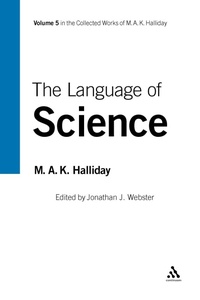
Language of Science
Volume 5
Published on 19. June 2006
Book
Paperback/Softback
268 pages
978-0-8264-8827-5 (ISBN)
Description
Halliday's investigations into grammatical metaphor take us deeply into the way we construct and expand meanings, starting with representations of concrete experienced events and ending with theoretical worlds populated by abstract entities linked through generalized relations and causalities. He finds these processes most strikingly in the development of the modern sciences that have historically created robust virtual worlds of theory from observable material events. He sees the same processes of grammatical metaphor as children learn to participate in our built symbolic environment, particularly as they are introduced to these meaning systems in schools, an institution designed expressly for that purpose.' Professor Charles Bazerman, University of California, Santa Barbara.
Reviews / Votes
"'Halliday's investigations into grammatical metaphor take us deeply into the way we construct and expand meanings, starting with representations of concrete experienced events and ending with a theoretical worlds populated by abstract entities linked through generalized relations and causalities. He finds these processes most strikingly in the development of the modern sciences that have historically created robust virtual worlds of theory from the observable material events of the world. But he sees these same processes in all the meaning systems of modern life, whether law, bureaucracy, economics, or arts. He sees the same processes of grammatical metaphor as children learn to participate in our built symbolic environment, particularly as they are introduced to these meaning systems in schools, an institution designed expressly for that purpose. The linguistic mechanisms Halliday identifies are congruent with Vygotsky's studies of how words come to direct our minds and perception, as individuals and societies. He shares with Vygotsky an understanding of how schooled or scientific concepts re-form the spontaneous concepts of everyday activity to sublate prior experience into higher degrees of abstraction. Both provide related accounts of how cultural history becomes embedded in the complex languages used in scientific, disciplined, or other cultural settings, so that we learn to think with the tools culture provides us, using our own aptitude for metaphorical thinking.' Professor Charles Bazerman, University of California, Santa Barbara."More details
Series
Language
English
Place of publication
London
United Kingdom
Publishing group
Bloomsbury Publishing PLC
Target group
College/higher education
Professional and scholarly
Undergraduates, Postgraduates, Academic
Dimensions
Height: 234 mm
Width: 156 mm
Thickness: 15 mm
Weight
412 gr
ISBN-13
978-0-8264-8827-5 (9780826488275)
Copyright in bibliographic data and cover images is held by Nielsen Book Services Limited or by the publishers or by their respective licensors: all rights reserved.
Schweitzer Classification
Other editions
Additional editions
E-Book
06/2006
1st Edition
Continuum Publishing Corporation
€100.99
Available for download
Persons
M. A. K. Halliday is Emeritus Professor at the University of Sydney. Jonathan Webster is Acting Head, Department of Chinese, Translation and Linguistics, at the City University of Hong Kong.
Content
Introduction: How Big is a Language?; Part One: Grammatical Metaphor; 1. Language and the Reshaping of Human Experience; 2. Language and Knowledge: the 'Unpacking' of Text; 3. Things and Relations: Regrammaticizing Experience as Technical Knowledge; 4. The Grammatical Construction of Scientific Knowledge: the. Framing of the English Clause; Part Two: Scientific English; 5. On the Language of Physical Science; 6. Some Grammatical Problems in Scientific English; 7. On the Grammar of Scientific English; 8. Writing Science: Literacy and Discursive Power.