

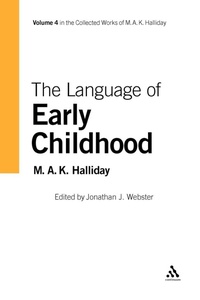
Language of Early Childhood
Published on 20. January 2006
Book
Paperback/Softback
430 pages
978-0-8264-8825-1 (ISBN)
Description
For nearly half a century, Professor M. A. K. Halliday has been enriching the discipline of linguistics with his keen insights into the social semiotic phenomenon we call language. This ten-volume series presents the seminal works of Professor Halliday. This fourth volume contains sixteen papers that look at the development of early childhood language. They are presented in three parts: infancy and protolanguage; the transition from child tongue to mother tongue; and early language and learning. The sociolinguistic account of the early development of the mother tongue presented by Professor Halliday is based on his intensive study of the language of one particular child, Nigel, for the period from nine- to eighteen months. The complete 'Nigel Transcripts' are included as a CD with this volume.
More details
Series
Language
English
Place of publication
London
United Kingdom
Publishing group
Bloomsbury Publishing PLC
Target group
College/higher education
Professional and scholarly
Dimensions
Height: 234 mm
Width: 156 mm
Thickness: 24 mm
Weight
649 gr
ISBN-13
978-0-8264-8825-1 (9780826488251)
Copyright in bibliographic data and cover images is held by Nielsen Book Services Limited or by the publishers or by their respective licensors: all rights reserved.
Schweitzer Classification
Persons
M. A. K. Halliday is Emeritus Professor at the University of Sydney. As a self-styled 'generalist' he has published in many branches of linguistics, both theoretical and applied. The volumes in this series encompass these aspects of Halliday's work.
Content
Part One: Infancy and Protolanguage; 1. Representing the Child as a Semiotic Being; 2. Learning How to Mean; 3. Early Language Learning: A Sociolinguistic Approach; 4. A Sociosemiotic Perspective on Language Development; 5. Meaning and the Construction of Reality in Early Childhood; 6. The Ontogenesis of Dialogue; Part Two: Transition from Child Tongue to Mother Tongue; 7. Into the Adult Language; 8. The Contribution of Developmental Linguistics to the Interpretation of Language as a System; 9. On the Transition from Child Tongue to Mother Tongue; 10. A Systemic-Functional Interpretation of the Nature and Ontogenesis of Dialogue; 11. The Place of Dialogue in Children's Construction of Meaning; Part Three: Early Language and Learning; 12. Relevant Models of Language; 13. The Social Context of Language Development; 14. Three Aspects of Children's Language Development: Learning Language, Learning through Language, Learning about Language; 15. Towards a Language-Based Theory of Learning; 16. Grammar and the Construction of Educational Knowledge.