

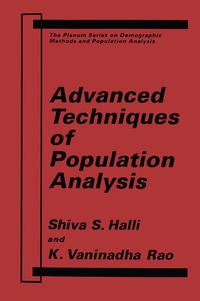
Advanced Techniques of Population Analysis
Published on 31. March 1992
Book
Paperback/Softback
XVI, 226 pages
978-0-306-43997-1 (ISBN)
Description
Although I feel honored to write a foreword for this important book, it is a task that I approach with some trepidation. The topics covered in the book summarize the current state of the art in technical demography. However, my knowledge and expertise with respect to technical demography are limited to the most fundamental and intermediate-level methods; hence, critical commentary on the contents of this volume is beyond my scope in this fore word. Since I have some understanding of the logic and substantive aspects of the methods rather than the complicated mathematics used in describing them, my comments will necessarily be restricted to the book's general or ganization and content. To date, most texts published on technical demography have been limited to traditional demographic methods: sources and limitations of data, life table construction and applications, standardization techniques, various methods for preparing population estimates and forecasts, etc. However, population specialists have in recent years been developing and successfully applying a variety of sophisticated techniques not covered in the more standard intro ductory texts. In addition, many traditional methods that are unique to the demographic discipline have been improved and extended.
More details
Series
Edition
1992 ed.
Language
English
Place of publication
New York
United States
Publishing group
Springer Science+Business Media
Target group
Professional and scholarly
Research
Illustrations
14 s/w Abbildungen
XVI, 226 p. 14 illus.
Dimensions
Height: 229 mm
Width: 152 mm
Thickness: 14 mm
Weight
360 gr
ISBN-13
978-0-306-43997-1 (9780306439971)
DOI
10.1007/978-1-4757-9030-6
Schweitzer Classification
Content
1. Basic Demographic Methods.- 2. Life Table Approaches to Demographic Analysis.- 3. Age, Period, and Cohort Effects in Demography.- 4. Causal Relationships in Population Analysis.- 5. Logistic and Probit Models.- 6. Log-Linear Models.- 7. Demographic Models.- 8. The Parametric Failure Time Models.- 9. Multiregional Demographic Models.- References.