

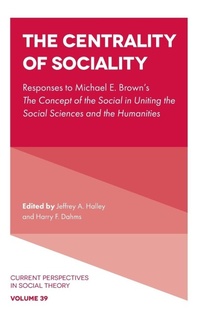
The Centrality of Sociality
Responses to Michael E. Brown's The Concept of the Social in Uniting the Social Sciences and the Humanities
Published on 12. December 2022
Book
Hardback
280 pages
978-1-80262-362-8 (ISBN)
Description
What do we mean by the word "social?" In The Centrality of Sociality, scholars respond to themes of The Concept of the Social in Uniting the Social Sciences and Humanities in dialogue with Michael E. Brown.
The Centrality of Sociality provides analyses of important distinctions between individual and society, agency-dependent and agency-independent objectivity, subject and object, theory and theorizing, and action and "course of activity." Apart from its theoretical interest, the book raises questions about the compelling idea that "the individual is the ultimate referent of moral discourse," formulating the question "what is human about human affairs" in such a way that the difficulties involved in defining the word individual appear to place in jeopardy the idea of the individual. The chapters analyze themes such as the conceptualization of the social vis-a-vis the individual, theories of action, and notions of subject-object relations.
A thought-provoking collection of research, this edited volume is key reading for scholars and researchers in sociology.
The Centrality of Sociality provides analyses of important distinctions between individual and society, agency-dependent and agency-independent objectivity, subject and object, theory and theorizing, and action and "course of activity." Apart from its theoretical interest, the book raises questions about the compelling idea that "the individual is the ultimate referent of moral discourse," formulating the question "what is human about human affairs" in such a way that the difficulties involved in defining the word individual appear to place in jeopardy the idea of the individual. The chapters analyze themes such as the conceptualization of the social vis-a-vis the individual, theories of action, and notions of subject-object relations.
A thought-provoking collection of research, this edited volume is key reading for scholars and researchers in sociology.
More details
Series
Language
English
Place of publication
Bingley
United Kingdom
Target group
Professional and scholarly
Dimensions
Height: 235 mm
Width: 157 mm
Thickness: 20 mm
Weight
560 gr
ISBN-13
978-1-80262-362-8 (9781802623628)
Copyright in bibliographic data and cover images is held by Nielsen Book Services Limited or by the publishers or by their respective licensors: all rights reserved.
Schweitzer Classification
Other editions
Additional editions
Jeffrey A. Halley | Harry F. Dahms
The Centrality of Sociality
Responses to Michael E. Brown's The Concept of the Social in Uniting the Social Sciences and the Humanities
E-Book
12/2022
1st Edition
Emerald Publishing Limited
€103.99
Available for download
Persons
Jeffrey A. Halley is Professor Emeritus of Sociology, The University of Texas at San Antonio, USA. Past President of RC Sociology of the Arts, ISA, Chair-Elect of the ASA History of Sociology and Social Thought Section, he was a Fulbright Fellow, and guest Professor at the Universities of Ljubljana, Metz, and the Ecole des Hautes Etudes en Sciences Sociales.
Harry F. Dahms is Professor of Sociology, co-director of the Center for the Study of Social Justice, and co-chair of the Committee of Social Theory at the University of Tennessee - Knoxville, director of the International Social Theory Consortium, and editor of Current Perspectives in Social Theory.
Harry F. Dahms is Professor of Sociology, co-director of the Center for the Study of Social Justice, and co-chair of the Committee of Social Theory at the University of Tennessee - Knoxville, director of the International Social Theory Consortium, and editor of Current Perspectives in Social Theory.
Content
Introduction: What is Human about Human Affairs?; Jeffrey A. Halley and Harry F. Dahms
Chapter 1. Consciousness and Crisis: Durkheim, Marx, Spinoza and Revolutionary vs Reactionary Spirit Today; Roslyn Wallach Bologh
Chapter 2. The Uncertainties of the Social; Jean-Louis Fabiani
Chapter 3. Brown on Sociality and the Social; Peter K. Manning
Chapter 4. Brown's "The Course of Activity": Non-Repeatability, the Avant-garde, and Temporality; Jeffrey A. Halley
Chapter 5. The Concept of Sociality in the Literary Criticism of Georg Lukacs, Lucien Goldmann and Theodor W. Adorno; Daglind E. Sonolet
Chapter 6. In Defense of the Social: Convergences and Divergences between the Humanities and Social Sciences in the United States; Harry F. Dahms
Chapter 7. The Ontology of the Social as a Theory of Social Forms; Michael J. Thompson
Chapter 8. Other Voices: The Concept of Heteroglossia in Michael E. Brown's Concept of the Social in Uniting the Humanities and Social Sciences; Allen Dunn
Chapter 9. Conceptual Implications in Social Sciences for Inquiring into the Social. Insights from Michael E. Brown's The Concept of the Social in Uniting the Social Sciences and Humanities; Ilaria Riccioni
Chapter 10. Theorizing, Bounded Rationality, and Expertise: Cognitive Sociology and the Quasi-Realism of Problem-Solving as a Course of Activity; Michael W. Raphael
Chapter 11. Response: What Is Distinctively Human About Human Affairs: Sociality and the Question of Society; Michael E. Brown.
Chapter 1. Consciousness and Crisis: Durkheim, Marx, Spinoza and Revolutionary vs Reactionary Spirit Today; Roslyn Wallach Bologh
Chapter 2. The Uncertainties of the Social; Jean-Louis Fabiani
Chapter 3. Brown on Sociality and the Social; Peter K. Manning
Chapter 4. Brown's "The Course of Activity": Non-Repeatability, the Avant-garde, and Temporality; Jeffrey A. Halley
Chapter 5. The Concept of Sociality in the Literary Criticism of Georg Lukacs, Lucien Goldmann and Theodor W. Adorno; Daglind E. Sonolet
Chapter 6. In Defense of the Social: Convergences and Divergences between the Humanities and Social Sciences in the United States; Harry F. Dahms
Chapter 7. The Ontology of the Social as a Theory of Social Forms; Michael J. Thompson
Chapter 8. Other Voices: The Concept of Heteroglossia in Michael E. Brown's Concept of the Social in Uniting the Humanities and Social Sciences; Allen Dunn
Chapter 9. Conceptual Implications in Social Sciences for Inquiring into the Social. Insights from Michael E. Brown's The Concept of the Social in Uniting the Social Sciences and Humanities; Ilaria Riccioni
Chapter 10. Theorizing, Bounded Rationality, and Expertise: Cognitive Sociology and the Quasi-Realism of Problem-Solving as a Course of Activity; Michael W. Raphael
Chapter 11. Response: What Is Distinctively Human About Human Affairs: Sociality and the Question of Society; Michael E. Brown.