

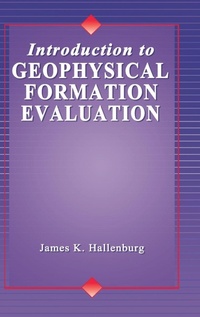
Introduction to Geophysical Formation Evaluation
1st Edition
Published on 29. December 1997
Book
Hardback
IX, 181 pages
978-1-56670-263-8 (ISBN)
Description
These three works cover the entire field of formation evaluation, from basic concepts and theories, through standard methods used by the petroleum industry, on to new and exciting applications in environmental science and engineering, hydrogeology, and other fields. Designed to be used individually or as a set, these volumes represent the first comprehensive assessment of all exploration methodologies. No other books offer the breadth of information and range of applications available in this set.
The first volume, Introduction to Geophysical Formation Evaluation, is the perfect introductory reference for environmental professionals without previous training in the field. It explains the fundamentals of geophysical exploration and analysis, illuminates the underlying theories, and offers practical guidance on how to use the available methodologies. General information on material behavior, porosity, tortuosity, permeability, cores, resistivity, radioactivity, and more provides a solid foundation for more advanced studies.
The second volume, Standard Methods of Geophysical Formation Evaluation builds on the basic precepts presented in the first work but can be used alone as a self-contained reference. It covers all the petroleum-oriented standard methods which, until recently, have comprised the majority of applications of geophysical formation evaluation. It also points out non-hydrocarbon uses of petroleum methods. This volume provides complete practical information and instructions on using the standard exploration and evaluation methods. It presents comprehensive, painstakingly detailed instructions for resistivity, radiation, and acoustic methods.
The third volume, Non-Hydrocarbon Methods of Geophysical Formation Evaluation, discusses uses of formation evaluation in environmental science and engineering, hydrogeology, and other fields outside the petroleum industry, and demonstrates how the standard methods can be adapted to these non-hydrocarbon purposes. It presents step-by-step instructions for photon, magnetic, nuclear, and acoustic methods of exploration, and gives special attention to the analytical techniques used in non-hydrocarbon exploration.
Individually, each book is a complete, stand-alone reference on an important area of this changing field. Together, the three volumes provide the most complete practical compendium available on all aspects of formation evaluation.
The first volume, Introduction to Geophysical Formation Evaluation, is the perfect introductory reference for environmental professionals without previous training in the field. It explains the fundamentals of geophysical exploration and analysis, illuminates the underlying theories, and offers practical guidance on how to use the available methodologies. General information on material behavior, porosity, tortuosity, permeability, cores, resistivity, radioactivity, and more provides a solid foundation for more advanced studies.
The second volume, Standard Methods of Geophysical Formation Evaluation builds on the basic precepts presented in the first work but can be used alone as a self-contained reference. It covers all the petroleum-oriented standard methods which, until recently, have comprised the majority of applications of geophysical formation evaluation. It also points out non-hydrocarbon uses of petroleum methods. This volume provides complete practical information and instructions on using the standard exploration and evaluation methods. It presents comprehensive, painstakingly detailed instructions for resistivity, radiation, and acoustic methods.
The third volume, Non-Hydrocarbon Methods of Geophysical Formation Evaluation, discusses uses of formation evaluation in environmental science and engineering, hydrogeology, and other fields outside the petroleum industry, and demonstrates how the standard methods can be adapted to these non-hydrocarbon purposes. It presents step-by-step instructions for photon, magnetic, nuclear, and acoustic methods of exploration, and gives special attention to the analytical techniques used in non-hydrocarbon exploration.
Individually, each book is a complete, stand-alone reference on an important area of this changing field. Together, the three volumes provide the most complete practical compendium available on all aspects of formation evaluation.
More details
Language
English
Place of publication
Bosa Roca
United States
Publishing group
Taylor & Francis Inc
Target group
College/higher education
Professional and scholarly
Academic and Professional Practice & Development
Illustrations
11 s/w Photographien bzw. Rasterbilder, 19 s/w Tabellen
19 Tables, black and white; 11 Halftones, black and white
Dimensions
Height: 240 mm
Width: 161 mm
Thickness: 15 mm
Weight
458 gr
ISBN-13
978-1-56670-263-8 (9781566702638)
Schweitzer Classification
Other editions
Additional editions
James K. Hallenburg
Introduction to Geophysical Formation Evaluation
E-Book
04/2023
1st Edition
CRC Press
€92.49
Available for download
James K. Hallenburg
Introduction to Geophysical Formation Evaluation
E-Book
04/2023
1st Edition
CRC Press
€92.49
Available for download
James K. Hallenburg
Introduction to Geophysical Formation Evaluation
Book
09/2019
1st Edition
CRC Press
€100.00
Shipment within 15-20 days
Person
Hallenburg\, James K.
Content
Introduction. History. Formation Materials Characteristics. Porosity, Permeability, Tortuosity, Saturation. Borehole, Mud, and Formation Effects. Cores, Core Analysis, and Cuttings. Introduction to Electric Resistance and Resistivity. Introduction to Radioactivity. Index.