

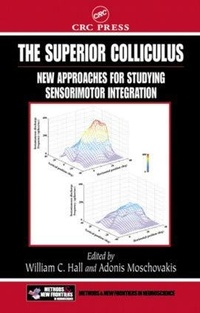
The Superior Colliculus
New Approaches for Studying Sensorimotor Integration
1st Edition
Will be published approx. on 25. September 2003
Book
Hardback
344 pages
978-0-8493-0097-4 (ISBN)
Description
The Superior Colliculus: New Approaches for Studying Sensorimotor Integration discusses new experimental and theoretical approaches to investigating how the brain transforms sensory signals into the motor commands that are used to shift the direction of gaze. The material includes the potential models for sensorimotor integration in the primate brain, how computational models and experimental work can be integrated to test hypotheses about sensorimotor integration, models of how multiple cortical and subcortical structures interact to generate a single behavior, and a description of new methods to correlate behavior and neural function.
More details
Language
English
Place of publication
Bosa Roca
United States
Publishing group
Taylor & Francis Inc
Target group
College/higher education
Professional and scholarly
Product notice
sewn/stitched
Cloth over boards
Illustrations
89 Illustrations, black and white
Dimensions
Height: 246 mm
Width: 152 mm
Thickness: 23 mm
Weight
617 gr
ISBN-13
978-0-8493-0097-4 (9780849300974)
Copyright in bibliographic data and cover images is held by Nielsen Book Services Limited or by the publishers or by their respective licensors: all rights reserved.
Schweitzer Classification
Other editions
Additional editions
William C. Hall | Adonis K. Moschovakis
The Superior Colliculus
New Approaches for Studying Sensorimotor Integration
E-Book
09/2003
CRC Press
€264.99
Available for download
William C. Hall | Adonis K. Moschovakis
The Superior Colliculus
New Approaches for Studying Sensorimotor Integration
E-Book
09/2003
1st Edition
CRC Press
€264.99
Available for download
Persons
Hall\, William C.; Moschovakis\, Adonis K.
Content
Presenting information amassed from more than 30 years of research, this book gathers together the most important pieces of evidence regarding the structure and function of the superior colliculus. It explores the involvement of the superior colliculus in the control of gaze shift and rapid eye movements and provides a detailed discussion of structural features as they relate to functional properties. Placing empirical data in the context of theory, the editors use computational models of the superior colliculus as scaffolds around which to organize psychophysical, neurological, anatomical, and physiological findings concerning its involvement in orienting movements.