

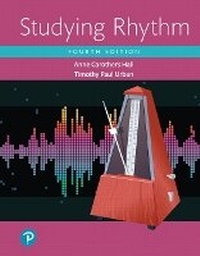
Studying Rhythm
4th Edition
Will be published approx. on 9. October 2018
Book
Spiral bound
256 pages
978-0-13-383921-0 (ISBN)
Description
For courses in Music Theory, Musical Skills, or Sight Singing.
A thorough, practical introduction to rhythm
Studying Rhythm introduces students to the basic processes and complexities of musical rhythm and helps them develop the ability to perform all kinds of rhythmic patterns accurately at sight. Authors Anne Hall and Timothy Urban provide students over 300 one- and two-part rhythmic studies, each with short preliminary exercises, that are intended to be sung, spoken, and tapped or clapped. The Fourth Edition offers fresh examples from the standard repertory as well as new material on structured improvisation.
A thorough, practical introduction to rhythm
Studying Rhythm introduces students to the basic processes and complexities of musical rhythm and helps them develop the ability to perform all kinds of rhythmic patterns accurately at sight. Authors Anne Hall and Timothy Urban provide students over 300 one- and two-part rhythmic studies, each with short preliminary exercises, that are intended to be sung, spoken, and tapped or clapped. The Fourth Edition offers fresh examples from the standard repertory as well as new material on structured improvisation.
More details
Edition
4th edition
Language
English
Place of publication
United States
Publishing group
Pearson Education (US)
Target group
Professional and scholarly
Dimensions
Height: 100 mm
Width: 100 mm
Thickness: 100 mm
Weight
100 gr
ISBN-13
978-0-13-383921-0 (9780133839210)
Copyright in bibliographic data and cover images is held by Nielsen Book Services Limited or by the publishers or by their respective licensors: all rights reserved.
Schweitzer Classification
Other editions
Previous edition
Anne Carothers Hall
Studying Rhythm
Book
10/2004
3rd Edition
Pearson
€115.12
Article exhausted; check for reprint
Persons
About our authors Anne Hall earned B.M., M.M., and Ph.D. degrees at the University of Michigan and studied in Paris with Nadia Boulanger for 3 years. After teaching at Mars Hill College in North Carolina and St. Olaf College in Minnesota, in 1976 she joined, as Director of Music Theory, the fledgling Faculty of Music at Wilfrid Laurier University in Waterloo, Ontario, where she taught until her retirement in 1999. For her last 10 years there she served as Dean of the Faculty of Music.
Although she had also taught piano and music history, she focused her teaching on music theory, especially theory of twentieth-century music, and on musical skills, the importance of which had been emphasized in her study in Paris. For the B.Mus. program at Laurier, she developed 4-year programs in music theory and musical skills. For the latter she composed the first version of Studying Rhythm in the early 1980s.
She served as Co-Chair of Minnesota Women in Higher Education, and later as the first chair of the Status of Women Committee of the Society for Music Theory, and then as the first chair of the Committee on Diversity of the SMT. She also served for 6 years on the Board of the Canadian University Music Society, including 2 years as President.
A major project, begun in 1980, was initiating and editing Jana Skarecky's translation of Zaklady Moderni Harmonie by Karel Jane ek, Czech composer and theorist. This book, Foundations of Modern Harmony, is scheduled to be published in 2017 by the AMU Press in Prague.
Timothy Urban has been teaching undergraduate aural skills classes at the Mason Gross School of the Arts of Rutgers University for the past 20 years and gives regular clinics and workshops on aural skills pedagogy as well as advising teachers wishing to develop or enhance existing aural skills programs. He received his Ph.D. from Rutgers University after having been a Fulbright scholar at the Kodaly Institute, Hungary. He holds graduate performance degrees in recorder and voice as well as an M.F.A in Early Music Performance Practice and continues to perform regularly as both singer and instrumentalist.
Although she had also taught piano and music history, she focused her teaching on music theory, especially theory of twentieth-century music, and on musical skills, the importance of which had been emphasized in her study in Paris. For the B.Mus. program at Laurier, she developed 4-year programs in music theory and musical skills. For the latter she composed the first version of Studying Rhythm in the early 1980s.
She served as Co-Chair of Minnesota Women in Higher Education, and later as the first chair of the Status of Women Committee of the Society for Music Theory, and then as the first chair of the Committee on Diversity of the SMT. She also served for 6 years on the Board of the Canadian University Music Society, including 2 years as President.
A major project, begun in 1980, was initiating and editing Jana Skarecky's translation of Zaklady Moderni Harmonie by Karel Jane ek, Czech composer and theorist. This book, Foundations of Modern Harmony, is scheduled to be published in 2017 by the AMU Press in Prague.
Timothy Urban has been teaching undergraduate aural skills classes at the Mason Gross School of the Arts of Rutgers University for the past 20 years and gives regular clinics and workshops on aural skills pedagogy as well as advising teachers wishing to develop or enhance existing aural skills programs. He received his Ph.D. from Rutgers University after having been a Fulbright scholar at the Kodaly Institute, Hungary. He holds graduate performance degrees in recorder and voice as well as an M.F.A in Early Music Performance Practice and continues to perform regularly as both singer and instrumentalist.
Content
Simple Duple Meter
Simple Triple Meter
Simple Quadruple Meter
Dotted Quarters and Tied Notes in Simple Meter
Compound Duple Meter
Sixteenth Notes in Simple Meter
Dotted Eighths in Simple Meter
Sixteenth Notes in Six-Eight Meter
More Rests and Syncopation in Simple Meter
More Rests and Syncopation in Six-Eight Meter
Nine-Eight and Twelve-Eight Meter
Triplets
Two Against Three
Half-Note Beat (Simple Meter)
Dotted-Half-Note Beat (Compound Meter)
Eighth Note Beat
Dotted Eighth Note Beat (Compound Meter)
Small Subdivisions
Changing Simple Meter
Changing Compound Meter
Changing between Simple and Compound Meter with the Division Constant
Changing between Simple and Compound Meter with the Beat Constant
Three Notes in Two Beats and Two Notes in Three Beats
Four Against Three
Four Notes in Three Beats and Three Notes in Four Beats
Quintuplets and Septuplets
Five-Eight and Five-Four Meter
More Meters with Unequal Beats
Changing Meters with Unequal Beats
More Cross Rhythms
Tempo Modulation
Simple Triple Meter
Simple Quadruple Meter
Dotted Quarters and Tied Notes in Simple Meter
Compound Duple Meter
Sixteenth Notes in Simple Meter
Dotted Eighths in Simple Meter
Sixteenth Notes in Six-Eight Meter
More Rests and Syncopation in Simple Meter
More Rests and Syncopation in Six-Eight Meter
Nine-Eight and Twelve-Eight Meter
Triplets
Two Against Three
Half-Note Beat (Simple Meter)
Dotted-Half-Note Beat (Compound Meter)
Eighth Note Beat
Dotted Eighth Note Beat (Compound Meter)
Small Subdivisions
Changing Simple Meter
Changing Compound Meter
Changing between Simple and Compound Meter with the Division Constant
Changing between Simple and Compound Meter with the Beat Constant
Three Notes in Two Beats and Two Notes in Three Beats
Four Against Three
Four Notes in Three Beats and Three Notes in Four Beats
Quintuplets and Septuplets
Five-Eight and Five-Four Meter
More Meters with Unequal Beats
Changing Meters with Unequal Beats
More Cross Rhythms
Tempo Modulation