

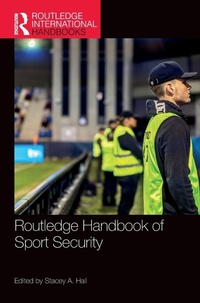
Routledge Handbook of Sport Security
1st Edition
Published on 1. September 2025
Book
Hardback
520 pages
978-1-032-64123-2 (ISBN)
Description
This book provides an in-depth analysis of security issues and concerns in contemporary sport. Featuring the work of leading researchers and practitioners from around the world, it offers practical, evidence-based commentary and guidance.
Drawing on the latest research evidence, the book examines the multiple stakeholders, agencies, and organizations involved in providing a safe space for spectators, participants, staff, organizations, communities, and sponsors. It considers the coordination of private and public entities in the sports security ecosystem, including facility management, event management, law enforcement, emergency management, emergency medical services, and state/federal government partners, as well as the private sector organizations providing support services. The book also offers a comprehensive analysis of key issues and debates in contemporary sport security, including terrorism, cybersecurity, spectator violence, planning and assessment guidance for sport venues and events of all sizes, management and policy considerations for leaders and decision-makers, and the lessons learned from critical incidents. It introduces the core principles of research methods in sport security and looks ahead at future developments in this rapidly changing field.
This is essential reading for any advanced student, researcher, practitioner, or policy-maker with an interest in sport studies, security studies, event studies, criminal justice, management, or public policy.
Drawing on the latest research evidence, the book examines the multiple stakeholders, agencies, and organizations involved in providing a safe space for spectators, participants, staff, organizations, communities, and sponsors. It considers the coordination of private and public entities in the sports security ecosystem, including facility management, event management, law enforcement, emergency management, emergency medical services, and state/federal government partners, as well as the private sector organizations providing support services. The book also offers a comprehensive analysis of key issues and debates in contemporary sport security, including terrorism, cybersecurity, spectator violence, planning and assessment guidance for sport venues and events of all sizes, management and policy considerations for leaders and decision-makers, and the lessons learned from critical incidents. It introduces the core principles of research methods in sport security and looks ahead at future developments in this rapidly changing field.
This is essential reading for any advanced student, researcher, practitioner, or policy-maker with an interest in sport studies, security studies, event studies, criminal justice, management, or public policy.
More details
Series
Language
English
Place of publication
London
United Kingdom
Publishing group
Taylor & Francis Ltd
Target group
Professional and scholarly
College/higher education
Postgraduate, Professional Reference, and Undergraduate Advanced
Illustrations
28 s/w Abbildungen, 6 s/w Photographien bzw. Rasterbilder, 22 s/w Zeichnungen, 22 s/w Tabellen
22 Tables, black and white; 22 Line drawings, black and white; 6 Halftones, black and white; 28 Illustrations, black and white
Dimensions
Height: 250 mm
Width: 175 mm
Thickness: 33 mm
Weight
1094 gr
ISBN-13
978-1-032-64123-2 (9781032641232)
Copyright in bibliographic data and cover images is held by Nielsen Book Services Limited or by the publishers or by their respective licensors: all rights reserved.
Schweitzer Classification
Other editions
Additional editions
Stacey A. Hall
Routledge Handbook of Sport Security
E-Book
09/2025
Routledge
€68.49
Available for download
Stacey A. Hall
Routledge Handbook of Sport Security
E-Book
09/2025
Routledge
€68.49
Available for download
Person
Stacey A. Hall is Professor and Executive Director at the National Center for Spectator Sports Safety and Security (NCS4) at the University of Southern Mississippi, USA. Dr. Hall leads the NCS4 mission to provide training, research, and outreach programs that promote the safety and security of sports and special events. Dr. Hall has published in leading international sport management, homeland security, and emergency management journals and has co-authored three textbooks. Dr. Hall has served as the principal investigator on federal grant awards to develop sport security training workshops for the first responder community and facility and event personnel.
Content
Part I: Introduction and Key Players, 1. The Sport Security Landscape, 2. Security Partners, Part II: Issues, 3. Sports as Soft Targets: The Terrorist Threat and Counterterrorism Considerations, 4. Perception of Risk and Terrorism: Impact on Elite Sporting Events, 5. Spectator Violence: Causes, Concerns, and Considerations, 6. Hooliganism - Origination, Trends, and Strategies for Securing Soccer Stadia, 7. Managing Large Crowds: The Application of Science, Tools, and Applied Strategies, 8. Hostile Vehicle Mitigation Planning for Sports Venues and Open-Access Events, 9. Bombing Prevention Planning for Sports and Special Events, 10. Severe Weather Impact on Sports and Preparedness Measures, 11. The Threat of Illegal Drones to Sports, 12. Cybersecurity Issues and Rules for Sports Organizations, 13. The Intersection of Human Trafficking and Large-Scale Events, 14. Sporting Events and Crime: A Meta Analysis, Part III: Planning and Assessment, 15. Securing International Sports Events, 16. Securing Professional Sports, 17. Securing College Sports, 18. Securing Youth Sports, 19. Sports Travel and Tourism Security, 20. Event Risk Assessment and Management, 21. The Importance of Information and Intelligence Sharing in Securing Sports, 22. Human Resource Needs and Professional Development, 23. Enhancing Preparedness Through Exercises, 24. Situational Crime Prevention (SCP) Application in Sports, Part IV: Management and Policy, 25. Emergency Response and Recovery Considerations for Sporting Events, 26. Integrating a Victim-Centred Approach into Emergency Management and Sports Security, 27. Evacuation and Protective Actions, 28. Crisis Management and Business Continuity, 29. Crisis and Risk Communications in Sport: Navigating the Complex Terrain, 30. Legal Considerations for Sport Venue Owners and Operators, 31. Negligent Security Litigation: Preparing for the Unexpected, 32. The Economic Impact of Securing Sports, 33. Balancing Security and the Guest Experience, 34. Ensuring Live Events are Accessible, Inclusive, and Safe For All, 35. Reframing Sport Venue Security: The Community-Driven Approach, Part V: Conclusion, 36. Critical Perspectives on Sport and Security, 37. Research Methods in Sport Safety and Security, 38. Sport Security Technology Trends and Solutions, 39. Lessons Learned from Security Incidents at Sports Venues and Events, 40. Sport Security Best Practices, Guidelines, and Resources: A Global Review