

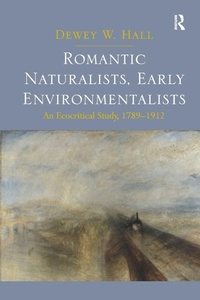
Romantic Naturalists, Early Environmentalists
An Ecocritical Study, 1789-1912
1st Edition
Published on 14. October 2024
Book
Paperback/Softback
240 pages
978-1-032-92589-9 (ISBN)
Description
In his study of Romantic naturalists and early environmentalists, Dewey W. Hall asserts that William Wordsworth and Ralph Waldo Emerson were transatlantic literary figures who were both influenced by the English naturalist Gilbert White. In Part 1, Hall examines evidence that as Romantic naturalists interested in meteorology, Wordsworth and Emerson engaged in proto-environmental activity that drew attention to the potential consequences of the locomotive's incursion into Windermere and Concord. In Part 2, Hall suggests that Wordsworth and Emerson shaped the early environmental movement through their work as poets-turned-naturalists, arguing that Wordsworth influenced Octavia Hill's contribution to the founding of the United Kingdom's National Trust in 1895, while Emerson inspired John Muir to spearhead the United States' National Parks movement in 1890. Hall's book traces the connection from White as a naturalist-turned-poet to Muir as the quintessential early environmental activist who camped in Yosemite with President Theodore Roosevelt. Throughout, Hall raises concerns about the growth of industrialization to make a persuasive case for literature's importance to the rise of environmentalism.
Reviews / Votes
'Romantic Naturalists, Early Environmentalists makes a contribution to scholarship in the field by bringing together a range of transatlantic authors - White, Wordsworth, Emerson, Hill, and Muir - to show their literary, philosophical, environmental, ecological, conservationist, and preservationist intersections. It is a wide-ranging study that makes connections not previously foregrounded in criticism.' Douglas Kneale, Brock University, Canada, author of Romantic Aversions: Aftermaths of Classicism in Wordsworth and Coleridge 'This book brings a historical perspective to the most important discussion of our time. It takes the observation and recording of natural phenomena by Gilbert White in eighteenth century Southern England as its starting point, showing how this seemingly simple activity influenced thinking through the nineteenth century. Dewey W. Hall clearly demonstrates the influence of the new sciences such as meteorology on the literature of two hundred years ago.' Jeff Cowton, Wordsworth Trust, UK 'This clearly written and enjoyable book makes an important contribution to lanscape studies ...' Environment and HistoryMore details
Language
English
Place of publication
London
United Kingdom
Publishing group
Taylor & Francis Ltd
Target group
Professional and scholarly
Academic
Dimensions
Height: 234 mm
Width: 156 mm
Weight
440 gr
ISBN-13
978-1-032-92589-9 (9781032925899)
Copyright in bibliographic data and cover images is held by Nielsen Book Services Limited or by the publishers or by their respective licensors: all rights reserved.
Schweitzer Classification
Other editions
Additional editions
E-Book
04/2016
Routledge
€55.49
Available for download
E-Book
04/2016
Routledge
€55.49
Available for download
Book
09/2014
1st Edition
Routledge
€215.77
Shipment within 10-20 days
Person
Dewey W. Hall is Professor of English at California State Polytechnic University, Pomona, USA. During his residence as a Mayers Research Fellow at the Huntington Library in 2012, he completed much of the writing for this book.
Content
Introduction, Dewey W. Hall; Part 1 Toward Romantic Naturalists; Chapter 1 Gilbert White's Legacy, Dewey W. Hall; Chapter 2 Romantic Naturalists: White, Wordsworth, and Otley, Dewey W. Hall; Chapter 3 Emerson, the Naturalist in Nature, Dewey W. Hall; Part 2 Toward Early Environmentalists; Chapter 4 Green Letters, Green Lectures, and the "Rash Assault", Dewey W. Hall; Chapter 5 Wordsworth, Octavia Hill, and the National Trust, Dewey W. Hall; Chapter 6 Emerson in Muir's Sierra and Our National Parks, Dewey W. Hall; Chapter 7 Shaping Muir, Reshaping Yosemite, Dewey W. Hall;