

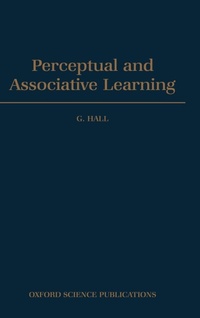
Perceptual and Associative Learning
Published on 28. November 1991
Book
Hardback
312 pages
978-0-19-852182-2 (ISBN)
Description
Traditional theories of associative learning have found no place for the possibility that the way in which events are perceived might change as a result of experience. Evidence for the reality of perceptual learning has come from those studied by learning theorists.
The work reviewed in this book shows that learned changes in perceptual organization can in fact be demonstrated, even in experiments using procedures (such as conditioning and simple discrimination learning) of the type on which associative theories have been based. These results come from procedures that have been the focus of detailed theoretical and empirical analysis; and from this analysis emerges an outline of the mechanisms responsible. Some of these are themselves associative; others require the addition of nonassociative mechanisms to the traditional theory. The result is an extended version of associative theory which, it is argued, will be relevant not only to the experimental procedures discussed in this book but to the entire range of instances of perceptual learning.
The work reviewed in this book shows that learned changes in perceptual organization can in fact be demonstrated, even in experiments using procedures (such as conditioning and simple discrimination learning) of the type on which associative theories have been based. These results come from procedures that have been the focus of detailed theoretical and empirical analysis; and from this analysis emerges an outline of the mechanisms responsible. Some of these are themselves associative; others require the addition of nonassociative mechanisms to the traditional theory. The result is an extended version of associative theory which, it is argued, will be relevant not only to the experimental procedures discussed in this book but to the entire range of instances of perceptual learning.
Reviews / Votes
Hall's arguments are based on many experiments, and are so detailed, subtle and variegated that they cannot be summarized here ... Hall's book is a tour de force: it convincingly explains a wide range of phenomena ... Hall is totally honest in reviewing both evidence and theories ... He suggests enough new experiments to keep workers in animal learning busy for year. And he exhibits great zest: one might say that he writes with faith, hope and clarity. * Stuart Sutherland, University of Sussex, Nature, Vol 356, March 1991 * he presents refreshingly objective and integrative interpretations of the data * Thomas R. Zentall, University of Kentucky, Science, Vol. 260, 1993 * The book is valuable because readers are introduced to contemporary associative theory and its continual refinement within well-researched experimental paradigms. Hall's book is valuable because of its rigorous analysis of issues surrounding the relationship between experience with stimuli and later associative learning. The book succeeds in linking together many important ideas from seemingly disparate theoretical approaches. For this reason, the book is clearly relevant to learning theorists. Because of the central role of perceptual and associative learning in cognitive and behavioral processes, it should also interest developmental psychologists. * John W. Moore, University of Massachusetts, American Journal of Psychology, Volume 107, number 3, Fall 1994 *More details
Series
Language
English
Place of publication
Oxford
United Kingdom
Publishing group
Oxford University Press
Target group
Professional and scholarly
Illustrations
numerous line illustrations
Dimensions
Height: 235 mm
Width: 157 mm
Thickness: 23 mm
Weight
666 gr
ISBN-13
978-0-19-852182-2 (9780198521822)
Copyright in bibliographic data and cover images is held by Nielsen Book Services Limited or by the publishers or by their respective licensors: all rights reserved.
Schweitzer Classification
Other editions
Additional editions
Geoffrey Hall
Perceptual and Associative Learning
E-Book
11/1991
1st Edition
OUP eBook
€96.49
Available for download
Person
Content
Associative theory and the phenomena of perceptual learning; Habituation; Latent inhibition as reduced associability; Latent inhibition as associative interference; Acquired distinctiveness: mediation and differentiation; Acquired distinctiveness: attentional factors; Discrimination after stimulus exposure; Learning and the modification of stimulus representations; References; Indexes.