

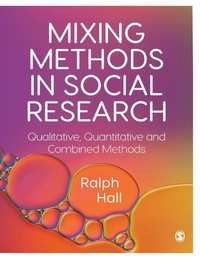
Mixing Methods in Social Research
Qualitative, Quantitative and Combined Methods
1st Edition
Published on 24. March 2020
Book
Hardback
272 pages
978-1-4462-8201-4 (ISBN)
Description
This book provides a straightforward, student-focused introduction to doing mixed methods research, covering everything from why and when mixed methods is appropriate, as well as how to use qualitative and quantitative methods in tandem.
Assuming no prior research methods knowledge, it introduces mixed methods alongside basic research theory and principles, fully integrating mixed methods into the research methods foundation. With clearly defined key terms and a structure that maps to the way students work on their projects, it progresses at a gradual pace suitable for mixed methods beginners.
Offering encouragement and tips for success throughout the full research process, Hall helps students confidently:
- Explain mixed methods paradigms and methodologies
- Define and choose a research approach
- Combine methods effectively
- Sample, collect, and analyze primary and secondary data
- Communicate and write up results.
Packed with tables, figures, and boxes that distill key concepts into retainable visuals, this book is the perfect companion to support students on their mixed methods projects.
Assuming no prior research methods knowledge, it introduces mixed methods alongside basic research theory and principles, fully integrating mixed methods into the research methods foundation. With clearly defined key terms and a structure that maps to the way students work on their projects, it progresses at a gradual pace suitable for mixed methods beginners.
Offering encouragement and tips for success throughout the full research process, Hall helps students confidently:
- Explain mixed methods paradigms and methodologies
- Define and choose a research approach
- Combine methods effectively
- Sample, collect, and analyze primary and secondary data
- Communicate and write up results.
Packed with tables, figures, and boxes that distill key concepts into retainable visuals, this book is the perfect companion to support students on their mixed methods projects.
More details
Language
English
Place of publication
London
United Kingdom
Target group
College/higher education
Dimensions
Height: 241 mm
Width: 196 mm
Thickness: 19 mm
Weight
707 gr
ISBN-13
978-1-4462-8201-4 (9781446282014)
Copyright in bibliographic data and cover images is held by Nielsen Book Services Limited or by the publishers or by their respective licensors: all rights reserved.
Schweitzer Classification
Other editions
Additional editions
Book
03/2020
1st Edition
SAGE Publications Ltd
€85.90
Shipment within 15-20 days
E-Book
02/2020
1st Edition
SAGE Publications Ltd
€76.49
Available for download
E-Book
02/2020
1st Edition
SAGE Publications Ltd
€76.49
Available for download
Person
Ralph Hall MA PhD AM is an Emeritus Professor in the School of Social Sciences at the University of New South Wales, Sydney Australia. He has taught research methods to both undergraduate and graduate students in the social science and policy program in the School since 1990. His research interests include the role of peer mentoring in facilitating incoming students adjustment to academic study, the work-study experience of students in addition to research designs in social research with particular reference to mixed-methods. He has co-edited one book with Lynn Scott, namely Global Issues: Perspectives on General Studies (MacMillan, 1987) and authored two, namely Impacts: Contemporary Issues and Global Problems with Roger Bell(MacMillan, 1996) and Applied Social Research: Planning, Designing and Conducting Real World Research. (Palgrave MacMillan, 2008). In 2019 he was awarded an AM (Member of the Order of Australia) for services to education as an academic and to the community.
Content
Part I: The Principles of Mixed Methods Research
Chapter 1: The Nature of Social Research and the Emergence of Mixed Methods
Chapter 2: Defining Paradigms and their use in Mixed Methods Research
Part II: Planning Social Research
Chapter 3: Defining the Research Problem and Reviewing the Literature
Chapter 4: Conceptual and Theoretical Frameworks in Social Research
Chapter 5: Choosing the Research Design
Chapter 6: Combining Methods in Mixed Methods Designs
Part III: Conducting Social Research
Chapter 7: Sampling Methods - Choosing Research Participants
Chapter 8: Collecting Data Using Self-Completion Questionnaires
Chapter 9: Collecting Data Using Interviews
Chapter 10: Collecting Data Using Observational Methods
Chapter 11: Collecting Secondary Data
Part IV: Organizing and Analyzing Research Data
Chapter 12: Preparing Data for Analysis
Chapter 13: Analyzing Quantitative Data
Chapter 14: Analyzing Qualitative Data
Chapter 15: Mixed Methods Data Analysis
Part V: Reporting, Presenting and Implementing Research Findings
Chapter 16: Interpreting Research Findings
Chapter 17: Communicating Research Findings
Chapter 18: Turning Research Results into Practice
Chapter 1: The Nature of Social Research and the Emergence of Mixed Methods
Chapter 2: Defining Paradigms and their use in Mixed Methods Research
Part II: Planning Social Research
Chapter 3: Defining the Research Problem and Reviewing the Literature
Chapter 4: Conceptual and Theoretical Frameworks in Social Research
Chapter 5: Choosing the Research Design
Chapter 6: Combining Methods in Mixed Methods Designs
Part III: Conducting Social Research
Chapter 7: Sampling Methods - Choosing Research Participants
Chapter 8: Collecting Data Using Self-Completion Questionnaires
Chapter 9: Collecting Data Using Interviews
Chapter 10: Collecting Data Using Observational Methods
Chapter 11: Collecting Secondary Data
Part IV: Organizing and Analyzing Research Data
Chapter 12: Preparing Data for Analysis
Chapter 13: Analyzing Quantitative Data
Chapter 14: Analyzing Qualitative Data
Chapter 15: Mixed Methods Data Analysis
Part V: Reporting, Presenting and Implementing Research Findings
Chapter 16: Interpreting Research Findings
Chapter 17: Communicating Research Findings
Chapter 18: Turning Research Results into Practice