

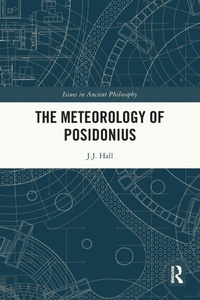
The Meteorology of Posidonius
1st Edition
Published on 18. December 2024
Book
Paperback/Softback
236 pages
978-1-032-53030-7 (ISBN)
Description
This volume describes the meteorology of the Stoic philosopher Posidonius from the existing fragments, and discusses his relation to earlier thinkers on this subject, as well as the methods he used to obtain information about and to find explanations of meteorological phenomena.
The book examines ancient meteorology, an aspect of ancient thought largely neglected by scholars. Hall produces a detailed account of how Posidonius and other ancient thinkers approached and attempted to explain meteorological phenomena - phenomena familiar to everyone, which could not be ignored in attempts to understand the natural world, but were difficult to explain satisfactorily and convincingly despite the efforts of important ancient thinkers. The volume explores particular classes of phenomena, including climatic events and geological processes, providing a comprehensive overview of Posidonius' ideas on these topics. Concluding chapters allow for an assessment of Posidonius' particular contribution to the field and his influence on later writers working on this subject.
The Meteorology of Posidonius provides an important resource for students and scholars working on ancient philosophy and ancient science, particularly ancient meteorology.
The book examines ancient meteorology, an aspect of ancient thought largely neglected by scholars. Hall produces a detailed account of how Posidonius and other ancient thinkers approached and attempted to explain meteorological phenomena - phenomena familiar to everyone, which could not be ignored in attempts to understand the natural world, but were difficult to explain satisfactorily and convincingly despite the efforts of important ancient thinkers. The volume explores particular classes of phenomena, including climatic events and geological processes, providing a comprehensive overview of Posidonius' ideas on these topics. Concluding chapters allow for an assessment of Posidonius' particular contribution to the field and his influence on later writers working on this subject.
The Meteorology of Posidonius provides an important resource for students and scholars working on ancient philosophy and ancient science, particularly ancient meteorology.
Reviews / Votes
"This judicious and clearly written exposition of the meteorological remains of Posidonius builds on the fundamental work of W. Theiler and especially of L. Edelstein and I.G. Kidd... As such, it is a welcome addition to the literature and only improves on re-reading." - The Classical Review"This is a most interesting and well researched book that covers a gap in scholarship... [it] allows us to see the lines that connect Posidonius to his predecessors in meteorology, especially Aristotle, and also appreciate his impact on the next generation of meteorologists, Stoics, Peripatetics, and Platonists alike." - Exemplaria Classica
More details
Series
Language
English
Place of publication
London
United Kingdom
Publishing group
Taylor & Francis Ltd
Target group
College/higher education
Professional and scholarly
Academic, Postgraduate, and Undergraduate Advanced
Illustrations
2 s/w Zeichnungen, 2 s/w Abbildungen
2 Line drawings, black and white; 2 Illustrations, black and white
Dimensions
Height: 234 mm
Width: 156 mm
Thickness: 14 mm
Weight
389 gr
ISBN-13
978-1-032-53030-7 (9781032530307)
Copyright in bibliographic data and cover images is held by Nielsen Book Services Limited or by the publishers or by their respective licensors: all rights reserved.
Schweitzer Classification
Other editions
Additional editions
J.J. Hall
The Meteorology of Posidonius
E-Book
07/2023
1st Edition
Routledge
€55.49
Available for download
J.J. Hall
The Meteorology of Posidonius
E-Book
07/2023
1st Edition
Routledge
€55.49
Available for download
J.J. Hall
The Meteorology of Posidonius
Book
07/2023
1st Edition
Routledge
€196.30
Shipment within 15-20 days
Person
J.J. Hall read Classics at Trinity College, Cambridge, and then did research, gaining a Ph.D. for a dissertation on ancient theories of wind. His career was spent on the staff of Cambridge University Library. Now retired, and still in Cambridge, U.K., he has written this book.
Content
1. The definition of "meteorology" used in this book; 2. The biography and later reputation of Posidonius; 3. Sources for the study of Posidonius' meteorology; 4. The history of Greek meteorology before Posidonius; 5. Earlier authors on meteorology used by Posidonius; 6. The region in which meteorological phenomena occur; 7. Climatic zones; 8. Thunder and lightning; 9. Lights in the sky: comets, the Milky Way and other phenomena; 10. Exhalations; 11. Winds; 12. Earthquakes and volcanoes; 13. The sea and its tides; 14. Rain, snow, hail and cloud; 15. Rivers: the Nile floods; 16. Rainbows, haloes and mock-suns; 17. Weather prediction and divination; 18. Meteorology and Providence; 19. Epicurean meteorology compared with that of the Stoics; 20. The place of meteorology among the different branches of knowledge; 21. Sources and methods in Posidonius' meteorology; 22. Assessment of the meteorology of Posidonius and his successors.