

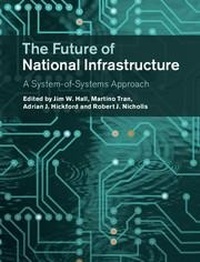
The Future of National Infrastructure
A System-of-Systems Approach
Published on 25. February 2016
Book
Hardback
338 pages
978-1-107-06602-1 (ISBN)
Description
Infrastructure forms the economic backbone of modern society. It is a key determinant of economic competitiveness, social well-being and environmental sustainability. Yet infrastructure systems (energy, transport, water, waste and ICT) in advanced economies globally face serious challenges. For the first time, a leading team of researchers sets out a systematic approach to making long-term choices about national infrastructure systems. Great Britain is used as a case study to demonstrate how the methodologies and accompanying models can be effectively applied in a national infrastructure assessment. Lessons and insights for other industrialised nations and emerging economies are highlighted, demonstrating practical scenarios for delivering infrastructure services in a wide range of future socio-economic and environmental conditions. The Future of National Infrastructure provides practitioners, policy-makers, and academics with the concepts, models and tools needed to identify and test robust, sustainable, and resilient strategies for the provision of national infrastructure.
More details
Language
English
Place of publication
Cambridge
United Kingdom
Target group
Professional and scholarly
Product notice
sewn/stitched
Cloth over boards
Illustrations
24 Tables, black and white; 122 Halftones, unspecified
Dimensions
Height: 256 mm
Width: 189 mm
Thickness: 20 mm
Weight
1134 gr
ISBN-13
978-1-107-06602-1 (9781107066021)
Copyright in bibliographic data and cover images is held by Nielsen Book Services Limited or by the publishers or by their respective licensors: all rights reserved.
Schweitzer Classification
Other editions
Additional editions
Jim W. Hall | Martino Tran | Adrian J. Hickford
The Future of National Infrastructure
A System-of-Systems Approach
E-Book
03/2016
Cambridge University Press
€112.99
Available for download
E-Book
02/2016
Cambridge University Press
€98.49
Available for download
Persons
Jim W. Hall is Director of the Environmental Change Institute and Professor of Climate and Environmental Risks in the University of Oxford. A civil engineer by background, Professor Hall has pioneered the use of risk analysis to inform tough decisions about the future of infrastructure systems. He advises governments, agencies and utilities globally on how to adapt their systems and plan for an uncertain future. Martino Tran is a Senior Research Fellow at the University of Oxford, and advises governments and industry on energy and environment. With a background in environmental science and mathematical modelling he applies systems thinking and decision sciences for addressing societal challenges in sustainability. He holds a doctorate from the University of Oxford and has published widely on the future impacts of technology on society and environment. Adrian J. Hickford is Senior Research Assistant in the Transportation Research Group at the University of Southampton. As well as his recent work on possible future changes to national infrastructure systems, he has been involved in a number of projects in the UK and across Europe aiming to increase the use of sustainable transport, reducing the associated risks, and improving current practices of traffic accident data gathering and use. Robert J. Nicholls, Professor of Coastal Engineering at the University of Southampton, is a coastal engineer with expertise in integrated assessment and systems perspectives and climate change impact and adaptation assessment. He was awarded the Roger Revelle Medal 2008 by the Intergovernmental Oceanographic Commission (IOC) Executive Council, which recognises outstanding contributions to the ocean sciences. He advises several national governments on coastal impacts and adaptation to climate change.
Content
List of contributors; Preface; Part I. A System-of-Systems Approach: 1. Introducing national infrastructure assessment Jim W. Hall, Robert J. Nicholls, Adrian J. Hickford and Martino Tran; 2. A framework for analysing the long-term performance of interdependent infrastructure systems Jim W. Hall, Alexander Otto, Adrian J. Hickford, Robert J. Nicholls and Martino Tran; Part II. Analysing National Infrastructure: 3. Future demand for infrastructure services Chris Thoung, Rachel Beaven, Chengchao Zuo, Mark Birkin, Peter Tyler, Douglas Crawford-Brown, Edward J. Oughton and Scott Kelly; 4. Energy systems assessment Pranab Baruah, Modassar Chaudry, Meysam Qadrdan, Nick Eyre and Nick Jenkins; 5. Transport systems assessment Simon P. Blainey and John M. Preston; 6. Water supply systems assessment Mike Simpson, Matthew C. Ives, Jim W. Hall and Chris G. Kilsby; 7. Wastewater systems assessment Lucy Manning, David W. Graham and Jim W. Hall; 8. Solid waste systems assessment Geoff V. R. Watson, Anne Stringfellow, William Powrie, David A. Turner and Jon Coello; 9. Digital communications and information systems Edward J. Oughton, Martino Tran, Cliff B. Jones and Razgar Ebrahimy; Part III. Integrative Perspectives for the Future: 10. Assessing the performance of national infrastructure strategies Martino Tran, Jim W. Hall, Robert J. Nicholls and Adrian J. Hickford; 11. Quantifying interdependencies: the energy-transport and water-energy nexus Martino Tran, Edward A. Byers, Simon P. Blainey, Pranab Baruah, Modassar Chaudry, Meysam Qadrdan, Nick Eyre and Nick Jenkins; 12. Analysing the risks of failure of interdependent infrastructure networks Raghav Pant, Scott Thacker, Jim W. Hall, Stuart Barr, David Alderson and Scott Kelly; 13. Database, simulation modelling and visualisation for national infrastructure assessment Stuart Barr, David Alderson, Matthew C. Ives and Craig Robson; 14. Governance of interdependent infrastructure networks Ralitsa Hiteva and Jim W. Watson; 15. The future of national infrastructure Jim W. Hall, Robert J. Nicholls, Martino Tran and Adrian J. Hickford; Index.