

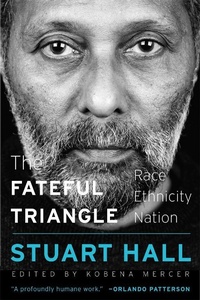
The Fateful Triangle
Race, Ethnicity, Nation
Published on 12. January 2021
Book
Paperback/Softback
256 pages
978-0-674-24834-2 (ISBN)
Description
"Given the current political conditions, these lectures on race, ethnicity, and nation, delivered by Stuart Hall almost a quarter of a century ago, may be even more timely today."
-Angela Y. Davis
In this defining statement one of the founding figures of cultural studies reflects on the divisive, often deadly consequences of our contemporary politics of race and identity. As he untangles the power relations that permeate categories of race, ethnicity, and nationhood, Stuart Hall shows how old hierarchies of human identity were forcefully broken apart when oppressed groups introduced new meanings to the representation of difference.
Hall challenges us to find more sustainable ways of living with difference, redefining nation, race, and identity.
"Stuart Hall bracingly confronts the persistence of race-and its confounding liberal surrogates, ethnicity and nation...This is a profoundly humane work that...finds room for hope and change."
-Orlando Patterson
"Stuart Hall's written words were ardent, discerning, recondite, and provocative, his spoken voice lyrical, euphonious, passionate, at times rhapsodic and he changed the way an entire generation of critics and commentators debated issues of race and cultural difference."
-Henry Louis Gates, Jr.
"Essential reading for those seeking to understand Hall's tremendous impact on scholars, artists, and filmmakers on both sides of the Atlantic."
-Artforum
-Angela Y. Davis
In this defining statement one of the founding figures of cultural studies reflects on the divisive, often deadly consequences of our contemporary politics of race and identity. As he untangles the power relations that permeate categories of race, ethnicity, and nationhood, Stuart Hall shows how old hierarchies of human identity were forcefully broken apart when oppressed groups introduced new meanings to the representation of difference.
Hall challenges us to find more sustainable ways of living with difference, redefining nation, race, and identity.
"Stuart Hall bracingly confronts the persistence of race-and its confounding liberal surrogates, ethnicity and nation...This is a profoundly humane work that...finds room for hope and change."
-Orlando Patterson
"Stuart Hall's written words were ardent, discerning, recondite, and provocative, his spoken voice lyrical, euphonious, passionate, at times rhapsodic and he changed the way an entire generation of critics and commentators debated issues of race and cultural difference."
-Henry Louis Gates, Jr.
"Essential reading for those seeking to understand Hall's tremendous impact on scholars, artists, and filmmakers on both sides of the Atlantic."
-Artforum
Reviews / Votes
Stuart Hall's written words were ardent, discerning, recondite, and provocative, his spoken voice lyrical, euphonious, passionate, at times rhapsodic and he changed the way an entire generation of critics and commentators debated issues of race and cultural difference. To keep up with him, you had to be curious and nimble. -- Henry Louis Gates, Jr. Promises to be essential reading for those seeking to understand Hall's tremendous impact on scholars, artists, and filmmakers on both sides of the Atlantic. -- Glenn Ligon * Artforum * Hall's main argument rests on the notion that the greatest problem of the 21st century is living with and understanding differences...The Fateful Triangle makes me recall the need to constantly question, interrogate and dismantle how we understand hierarchies of difference and identity; and how the position of outsiders is always part of a larger political question. -- Kalwant Bhopal * Times Higher Education * In this long awaited work, Stuart Hall, the invisibly Jamaican co-founder of British cultural studies, powerfully interrogates what is, simultaneously, the central dilemma of transatlantic black cultures and one of the most acute paradoxes of modern times. He bracingly confronts the persistence of race-and its confounding liberal surrogates, ethnicity and nation-as a marker of identification, a fervently embraced 'sliding signifier' among blacks and other formerly subaltern peoples, in spite of its scientific invalidation and horrendous past. This is a profoundly humane work that not only integrates African-American and Anglo-Caribbean cultural studies, but finds room for hope and change in the discursive nature of their subject. -- Orlando Patterson These lectures are a vital contribution to Stuart Hall's enduring vocation to find a critical voice which is, in equal measure, just and generous, reflective and transformative. Marked by struggle and sobriety, this important work makes a significant contribution to a vision of community and an ethics of solidarity. -- Homi K. Bhabha Given the current political conditions, these lectures on race, ethnicity, and nation, delivered by Stuart Hall almost a quarter of a century ago, may be even more timely today. He has left us a vital legacy of intellectual passion, analytical rigor, and political prescience that should be heeded, especially now, by progressive scholars and activists. -- Angela Y. Davis, University of California, Santa CruzMore details
Series
Language
English
Place of publication
Cambridge, Mass
United States
Target group
Professional and scholarly
Dimensions
Height: 183 mm
Width: 112 mm
Thickness: 17 mm
Weight
210 gr
ISBN-13
978-0-674-24834-2 (9780674248342)
Copyright in bibliographic data and cover images is held by Nielsen Book Services Limited or by the publishers or by their respective licensors: all rights reserved.
Schweitzer Classification
Persons
Stuart Hall was an influential Jamaican-born British sociologist and cultural theorist. He was Professor of Sociology at the Open University, the founding editor of New Left Review, and Director of the Centre for Contemporary Cultural Studies at the University of Birmingham. Kobena Mercer is Professor of History of Art and African American Studies at Yale University. Henry Louis Gates, Jr., is the author of numerous books and has written extensively on the history of race and anti-Black racism in the Enlightenment. His most recent works include Stony the Road and The Black Church. He is the Alphonse Fletcher University Professor and Director of the Hutchins Center for African and African American Research at Harvard University.