

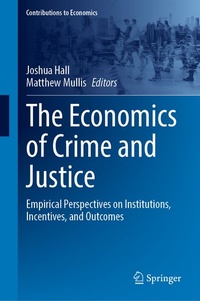
The Economics of Crime and Justice
Description
This edited volume presents a survey of empirical work on different aspects of the economics of crime and the legal system. The book begins by laying out the foundational ideas in the field and previewing the major themes, which span crime and development, incarceration, judicial behavior, capital punishment, policing, credit access, education, government revenue, and plea bargaining. The chapters that follow tackle a wide range of research questions. One strand of the volume examines how infrastructure and development shape criminal opportunity, using evidence from electricity blackouts in South Africa to explore whether darkness and disruption create conditions for increased criminal activity. Another strand focuses on the prison system, investigating whether the geographic distance between an inmate's home and their facility affects the likelihood of reoffending.
The volume also explores how access to secondary markets and education shape crime. The relationship between pawn shops and criminal activity is studied across both modern and historical settings, while another study evaluates whether alternative education programs reduce juvenile offending. Together, these chapters demonstrate how researchers from across different fields in economics contribute to our understanding of crime and the criminal justice system.
More details
Persons
Joshua Hall is the Milan Puskar Dean and Professor of Economics, all in the John Chambers College of Business & Economics at West Virginia University. He was the 2019-2020 Benedum Distinguished Scholar in Behavioral and Social Sciences and a 2015-2016 WVU Foundation Outstanding Teaching Award Recipient. He earned his bachelor and master degrees in economics from Ohio University and his Ph.D. from West Virginia University in 2007. Prior to returning to WVU, he was the Elbert H. Neese, Jr. Professor of Economics at Beloit College. He is author of over 100 peer-reviewed articles and editor of 15 books.
Matthew Mullis is a PhD Student in Economics at West Virginia University. His research fields are health and public economics. His current projects use administrative data to investigate consumer, firm, and government behavior in the gambling market.
Content
Chapter 1: Introduction to the Economics of Crime and Justice.- Chapter 2: Criminal Behavior During Electricity Blackouts: Evidence from Load Shedding in Cape Town, South Africa.- Chapter 3: Does Distance between Residence and Incarceration Facility Affect Recidivism? Evidence from the Florida Department of Corrections.- Chapter 4: Do Judges Vary Their Burden of Proof? Evidence from Federal Bench Trials.- Chapter 5: The Impact of Execution Moratoriums on Homicide Rates.- Chapter 6: Beat Cops and Beat Reporters: The Impact of local Press on Taxation by Citation.- Chapter 7: Three Golden Balls: Pawn Shops and Crime.- Chapter 8: Impact of Alternative Education Programs on Juvenile Crime.- Chapter 9: Efficiency Forfeited: A Frontier Analysis of Law Enforcement and Revenue Generation.- Chapter 10: Who Prefers Plea Bargaining? An Endogenous Institutions Experiment.