

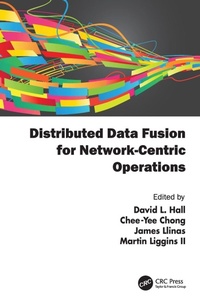
Distributed Data Fusion for Network-Centric Operations
1st Edition
Published on 29. March 2017
Book
Paperback/Softback
498 pages
978-1-138-07383-8 (ISBN)
Description
With the recent proliferation of service-oriented architectures (SOA), cloud computing technologies, and distributed-interconnected systems, distributed fusion is taking on a larger role in a variety of applications-from environmental monitoring and crisis management to intelligent buildings and defense. Drawing on the work of leading experts around the world, Distributed Data Fusion for Network-Centric Operations examines the state of the art of data fusion in a distributed sensing, communications, and computing environment.
Get Insight into Designing and Implementing Data Fusion in a Distributed Network
Addressing the entirety of information fusion, the contributors cover everything from signal and image processing, through estimation, to situation awareness. In particular, the work offers a timely look at the issues and solutions involving fusion within a distributed network enterprise. These include critical design problems, such as how to maintain a pedigree of agents or nodes that receive information, provide their contribution to the dataset, and pass to other network components. The book also tackles dynamic data sharing within a network-centric enterprise, distributed fusion effects on state estimation, graph-theoretic methods to optimize fusion performance, human engineering factors, and computer ontologies for higher levels of situation assessment.
A comprehensive introduction to this emerging field and its challenges, the book explores how data fusion can be used within grid, distributed, and cloud computing architectures. Bringing together both theoretical and applied research perspectives, this is a valuable reference for fusion researchers and practitioners. It offers guidance and insight for those working on the complex issues of designing and implementing distributed, decentralized information fusion.
Get Insight into Designing and Implementing Data Fusion in a Distributed Network
Addressing the entirety of information fusion, the contributors cover everything from signal and image processing, through estimation, to situation awareness. In particular, the work offers a timely look at the issues and solutions involving fusion within a distributed network enterprise. These include critical design problems, such as how to maintain a pedigree of agents or nodes that receive information, provide their contribution to the dataset, and pass to other network components. The book also tackles dynamic data sharing within a network-centric enterprise, distributed fusion effects on state estimation, graph-theoretic methods to optimize fusion performance, human engineering factors, and computer ontologies for higher levels of situation assessment.
A comprehensive introduction to this emerging field and its challenges, the book explores how data fusion can be used within grid, distributed, and cloud computing architectures. Bringing together both theoretical and applied research perspectives, this is a valuable reference for fusion researchers and practitioners. It offers guidance and insight for those working on the complex issues of designing and implementing distributed, decentralized information fusion.
Reviews / Votes
"... a collection of chapters from leading thinkers in this emerging field ... This book represents the best body of thinking on the emerging topic of distributed data fusion, including varied aspects of the problem itself and a multitude of approaches to address the stated challenges."-Dale Walsh, The MITRE Corporation, Gainesville, Virginia, USA
"This book addresses a very timely topic-the confluence of the emerging networked sensing and fusion, which leads to distributed data fusion of network-centric operations. ... The list of authors in this book reads like a 'Who's Who' in the field ... . Consequently, this book is very comprehensive and covers all the important topics needed by researchers in this area. Another attractive aspect of this book is that the list of authors includes theoreticians as well as practitioners of data fusion and network-centric systems. This provides the reader with the best of both worlds and some very unique perspectives."
-Raja Suresh, General Dynamics Advanced Information Systems, Vadnais Heights, Minnesota, USA
"This book provides a comprehensive introduction and detailed design descriptions of the methods for distributing the data fusion functions within grid, distributed, and cloud computing architectures."
-Ed Waltz, BAE Systems, Chantilly, Virginia, USA
"Written in a manner that particularly highlights topics of direct relevance to a Department of Defense reader ... As is typical for these editors, the chapters provide a well-organized, thorough review of the field from both a theoretical and applied research perspective. The book will most certainly serve as a useful tool for fusion researchers and practitioners alike as we continue to grapple with the critical issue of ensuring our data collection efforts have a clear and positive impact on mission outcome."
-From the Foreword by Barbara D. Broome, Chief, Information Sciences Division, U.S. Army Research Laboratory, Adelphi Laboratory Center, Maryland, USA "... a collection of chapters from leading thinkers in this emerging field ... This book represents the best body of thinking on the emerging topic of distributed data fusion, including varied aspects of the problem itself and a multitude of approaches to address the stated challenges."-Dale Walsh, The MITRE Corporation, Gainesville, Virginia, USA
"This book addresses a very timely topic-the confluence of the emerging networked sensing and fusion, which leads to distributed data fusion of network-centric operations. ... The list of authors in this book reads like a 'Who's Who' in the field ... . Consequently, this book is very comprehensive and covers all the important topics needed by researchers in this area. Another attractive aspect of this book is that the list of authors includes theoreticians as well as practitioners of data fusion and network-centric systems. This provides the reader with the best of both worlds and some very unique perspectives."-Raja Suresh, General Dynamics Advanced Information Systems, Vadnais Heights, Minnesota, USA
"This book provides a comprehensive introduction and detailed design descriptions of the methods for distributing the data fusion functions within grid, distributed, and cloud computing architectures."-Ed Waltz, BAE Systems, Chantilly, Virginia, USA
"Written in a manner that particularly highlights topics of direct relevance to a Department of Defense reader ... As is typical for these editors, the chapters provide a well-organized, thorough review of the field from both a theoretical and applied research perspective. The book will most certainly serve as a useful tool for fusion researchers and practitioners alike as we continue to grapple with the critical issue of ensuring our data collection efforts have a clear and positive impact on mission outcome." -From the Foreword by Barbara D. Broome, Chief, Information Sciences Division, U.S. Army Research Laboratory, Adelphi Laboratory Center, Maryland, USA
More details
Language
English
Place of publication
London
United Kingdom
Publishing group
Taylor & Francis Ltd
Target group
College/higher education
Government, industry, and academic researchers, system developers, and engineers working in data fusion cloud computing, signal processing, robotics and control, computer science and computer engineering, information theory, sensors, instrumentation and measurement, information fusion, aerospace engineering, and electronics; advanced undergraduate or graduate students studying distributed data fusion.
Illustrations
122 s/w Abbildungen, 25 s/w Tabellen
25 Tables, black and white; 122 Illustrations, black and white
Dimensions
Height: 234 mm
Width: 156 mm
Thickness: 27 mm
Weight
752 gr
ISBN-13
978-1-138-07383-8 (9781138073838)
Copyright in bibliographic data and cover images is held by Nielsen Book Services Limited or by the publishers or by their respective licensors: all rights reserved.
Schweitzer Classification
Other editions
Additional editions
David Hall | Chee-Yee Chong | James Llinas
Distributed Data Fusion for Network-Centric Operations
Book
07/2021
1st Edition
CRC Press
€253.79
Shipment within 15-20 days
David Hall | Chee-Yee Chong | James Llinas
Distributed Data Fusion for Network-Centric Operations
E-Book
12/2017
1st Edition
CRC Press
€118.99
Available for download
David Hall | Chee-Yee Chong | James Llinas
Distributed Data Fusion for Network-Centric Operations
E-Book
12/2017
CRC Press
€118.99
Available for download
Persons
Dr. David L. Hall is the dean for The Pennsylvania State University College of Information Sciences and Technology (IST). He also serves as a professor of IST and director of the Center for Network Centric Cognition and Information Fusion (NC2IF). Dr. Hall has industrial experience and has lectured internationally on the topics of multisensor data fusion, artificial intelligence, and research management and technology forecasting.
Dr. Chee-Yee Chong is a chief scientist at BAE Systems Technology Solutions. He has been involved in distributed fusion research for over 25 years, starting with the Distributed Sensor Networks (DSN) program for the U.S. Defense Advanced Research Projects Agency (DARPA) in the 1980s. Dr. Chong's research interests include centralized and distributed estimation, target tracking, information fusion, optimization and resource management, and application to real-world problems.
Dr. James Llinas is a professor emeritus at the State University of New York at Buffalo. He created the Center for Multisource Information Fusion (CMIF) at the University at Buffalo, the only university research center conducting information fusion research in a systemic context, and is currently director emeritus of the Center. An expert on data fusion, he has lectured internationally on the subject for over 20 years, co-authored the first integrated text on information fusion, and has consulted extensively and internationally for many years.
Martin E. Liggins II is an engineer with The MITRE Corporation. He has more than 20 years of research and development experience in industry and with the U.S. Department of Defense. He has performed fusion research in a number of areas, including sensor and data fusion, multisensor and multitarget tracking, radar, high-performance computing, and program management.
Dr. Chee-Yee Chong is a chief scientist at BAE Systems Technology Solutions. He has been involved in distributed fusion research for over 25 years, starting with the Distributed Sensor Networks (DSN) program for the U.S. Defense Advanced Research Projects Agency (DARPA) in the 1980s. Dr. Chong's research interests include centralized and distributed estimation, target tracking, information fusion, optimization and resource management, and application to real-world problems.
Dr. James Llinas is a professor emeritus at the State University of New York at Buffalo. He created the Center for Multisource Information Fusion (CMIF) at the University at Buffalo, the only university research center conducting information fusion research in a systemic context, and is currently director emeritus of the Center. An expert on data fusion, he has lectured internationally on the subject for over 20 years, co-authored the first integrated text on information fusion, and has consulted extensively and internationally for many years.
Martin E. Liggins II is an engineer with The MITRE Corporation. He has more than 20 years of research and development experience in industry and with the U.S. Department of Defense. He has performed fusion research in a number of areas, including sensor and data fusion, multisensor and multitarget tracking, radar, high-performance computing, and program management.
Content
Perspectives on Distributed Data Fusion. Distributed Data Fusion: Overarching Design Concerns and Some New Approaches. Network-Centric Concepts: Impacts to Distributed Fusion System Design. Distributed Detection in Wireless Sensor Networks. Fundamentals of Distributed Estimation. Essence of Distributed Target Tracking: Track Fusion and Track Association. Decentralized Data Fusion: Formulation and Algorithms. Toward a Theoretical Foundation for Distributed Fusion. Object Classification in a Distributed Environment. A Framework for Distributed High-Level Fusion. Threat Analysis in Distributed Environments. Ontological Structures for Higher Levels of Distributed Fusion. Service-Oriented Architecture for Human-Centric Information Fusion. Nonmyopic Sensor Management. Test and Evaluation of Distributed Data and Information Fusion Systems and Processes. Human Engineering Factors in Distributed and Net-Centric Fusion Systems. Distributed Data and Information Fusion in Visual Sensor Networks. Index.