

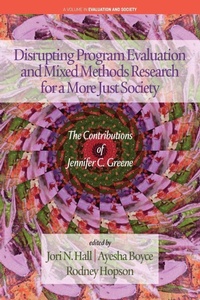
Disrupting Program Evaluation and Mixed Methods Research for a More Just Society
The Contributions of Jennifer C. Greene
Published on 13. December 2022
Book
Paperback/Softback
274 pages
979-8-88730-104-4 (ISBN)
Description
While women have influenced the fields of program evaluation and mixed methods research, their contributions are rarely acknowledged. In this edited volume, we recognize the contributions Jennifer C. Greene made to evaluation and mixed methods, focusing on how she disrupted traditional ways methods are conceptualized and implemented. We aim to provide a range of perspectives on how Greene disrupted social science theory, methodology, and training through her commitment to the values of democracy, diversity, and dialogue. Accordingly, the volume makes explicit how Greene democratized social science inquiry and training by emphasizing inclusive, culturally responsive, and educative theories, methods, and pedagogical practices. Second, it clarifies how her commitment to diversity supported scholars from diverse disciplinary backgrounds and cultures (within and beyond the United States) and validated often ignored perspectives on phenomena or experiences. And third, it showcases how her commitment to dialogue opened spaces for non-traditional methodological approaches that engage, communicate, and disseminate program evaluation and mixed methods work. Taken together, the first-hand accounts presented in this volume offer a historical perspective and practical guidance on program evaluation and mixed methods conceptualization, implementation, and training.
Reviews / Votes
The theme of 'disruption' in this book is a powerful look at the breadth and significance of Jennifer C. Greene's distinguished contributions, both theoretical and practical, in evaluation for over 30 years. In essence, these chapters reveal the sustaining power of her scholarship and influence today and likely in years to come. Her recognition that no single method can solve the complex problems faced in evaluation is revealed in the ontological, epistemological, and methodological work she developed on mixed methods, which led to a genre of study that recast the debate about the hegemony of quantitative over qualitative methods and vice versa. She has foregrounded values, the quintessential character of evaluation, by recognizing the multiplicity of perspectives that guide our theories, roles, questions, designs, and perceptions of quality. Jennifer Greene's generativity is exemplified in her egalitarian dialogic stance, inclusion of voices and context, and commitment to equity. The chapters reflect the impact of her work on scholars who continue to advance evaluation for a more just society. - Valerie J. Caracelli, U.S. Government Accountability Office""It is not possible to convey in a few words my strongest endorsement for this volume that begins scratching the surface of Jennifer C. Greene's many contributions to evaluation theory, methods, and practice. I have worked with and learned from her on many occasions over the years as I grappled with refining my understanding and practice of culturally responsive evaluation. I commend the editors and authors for this first substantive collection providing a more in-depth understanding and appreciation of Jennifer Greene's body of work for some while providing others the opportunity to revisit the lessons we have learned from her work, spirit, and commitment to make a difference."" - Stafford Hood, Center for Culturally Responsive Evaluation & Assessment (CREA) and Professor Emeritus University of Illinois at Urbana-Champaign
More details
Series
Language
English
Place of publication
Charlotte
United States
Publishing group
Emerald Publishing Inc
Target group
Professional and scholarly
Dimensions
Height: 234 mm
Width: 156 mm
Thickness: 15 mm
Weight
421 gr
ISBN-13
979-8-88730-104-4 (9798887301044)
Copyright in bibliographic data and cover images is held by Nielsen Book Services Limited or by the publishers or by their respective licensors: all rights reserved.
Schweitzer Classification
Other editions
Additional editions
Jori N. Hall | Ayesha Boyce | Rodney Hopson
Disrupting Program Evaluation and Mixed Methods Research for a More Just Society
The Contributions of Jennifer C. Greene
E-Book
01/2023
1st Edition
IAP - Information Age Publishing
€80.60
Available for download
Persons
Content
Preface.
Acknowledgments.
Introduction: Values, Legacy, History, Practice, and Critique.
Chapter 1. The Value Commitments of Jennifer C. Greene; Jori N. Hall and Janie Copple.
Chapter 2. Situating Jennifer C. Greene's Evaluation Legacy in the Illinois School of Evaluation; Rodney Hopson and Molly Galloway.
Chapter 3. From Multiple Methods to Mixed Methods, and From General Purposes to Specific Designs: The Greene Light; Melvin M. Mark.
Chapter 4. The Interpretivist-Humanist Evaluator; Thomas A. Schwandt.
Section I: Democratizing Inquiry: Fostering Inclusion, Collaboration, And Learning.
Chapter 5. Democratic Ideals in Research and Evaluation: Purposes, Puzzles, and the Public Good; Emily F. Gates, Priya Goel La Londe, Rebecca M. Teasdale, and Carolina Hidalgo Standen.
Chapter 6. Visiting and Listening Well: A Tribute to Jennifer C. Greene, the Gentle Disruptor; Veronica G. Thomas.
Chapter 7. Good Start: Creating Change From the Ground Up; Sharon Brisolara, Tristi Nichols, Kathryn A. Sielbeck-Mathes, and Denise Seigart.
Chapter 8. Evaluator's Commitment to Epistemic Justice and the Need of Ethics Work; Tineke A. Abma and Susan Woelders.
Section II: Diversifying Social Science Inquiry Nationally And Internationally Through Pedagogy And Mentorship.
Chapter 9. Answering the Call: Over Fifteen Years of Disrupting STEM Programming Through Values-Engaged, Educative Evaluation; Ayesha S. Boyce and Lorna Rivera.
Chapter 10. Our Evaluation Education With JCG: The Learn-Practice-Reflect Model; Julian T. Williams and Rafiqah B. Mustafaa.
Chapter 11. Crossing the Threshold: Jennifer C. Greene's Contribution to Disrupting Evaluation in the International Development Field; Alison Mathie.
Chapter 12. In Pursuit of Democratic Values: Transnational Influences on Jennifer C. Greene; Melissa R. Goodnight and Cherie M. Avent.
Section III: Meaningful Dialogue: Dispositions, Impositions, And Assumptions Matter.
Chapter 13. Micro-Level Processes of Dialogue for Transformative Evaluation Practice and a Just Society; Wenjin Guo, Leanne Kallemeyn, Elissa W. Frazier, and Eleanor Ngerchelei Titiml.
Chapter 14. Exploring the Linguistic Implications of Dialogue in Evaluation; Jill Anne Chouinard.
Chapter 15. Holding Space for Exploration, Reflection, and Growth; Sarita Davis and Alexis Kaminsky.
Section IV: The Last Word.
Chapter 16. Interview With Jennifer C. Greene.
About the Editors.
About the Contributors.
Index.
Acknowledgments.
Introduction: Values, Legacy, History, Practice, and Critique.
Chapter 1. The Value Commitments of Jennifer C. Greene; Jori N. Hall and Janie Copple.
Chapter 2. Situating Jennifer C. Greene's Evaluation Legacy in the Illinois School of Evaluation; Rodney Hopson and Molly Galloway.
Chapter 3. From Multiple Methods to Mixed Methods, and From General Purposes to Specific Designs: The Greene Light; Melvin M. Mark.
Chapter 4. The Interpretivist-Humanist Evaluator; Thomas A. Schwandt.
Section I: Democratizing Inquiry: Fostering Inclusion, Collaboration, And Learning.
Chapter 5. Democratic Ideals in Research and Evaluation: Purposes, Puzzles, and the Public Good; Emily F. Gates, Priya Goel La Londe, Rebecca M. Teasdale, and Carolina Hidalgo Standen.
Chapter 6. Visiting and Listening Well: A Tribute to Jennifer C. Greene, the Gentle Disruptor; Veronica G. Thomas.
Chapter 7. Good Start: Creating Change From the Ground Up; Sharon Brisolara, Tristi Nichols, Kathryn A. Sielbeck-Mathes, and Denise Seigart.
Chapter 8. Evaluator's Commitment to Epistemic Justice and the Need of Ethics Work; Tineke A. Abma and Susan Woelders.
Section II: Diversifying Social Science Inquiry Nationally And Internationally Through Pedagogy And Mentorship.
Chapter 9. Answering the Call: Over Fifteen Years of Disrupting STEM Programming Through Values-Engaged, Educative Evaluation; Ayesha S. Boyce and Lorna Rivera.
Chapter 10. Our Evaluation Education With JCG: The Learn-Practice-Reflect Model; Julian T. Williams and Rafiqah B. Mustafaa.
Chapter 11. Crossing the Threshold: Jennifer C. Greene's Contribution to Disrupting Evaluation in the International Development Field; Alison Mathie.
Chapter 12. In Pursuit of Democratic Values: Transnational Influences on Jennifer C. Greene; Melissa R. Goodnight and Cherie M. Avent.
Section III: Meaningful Dialogue: Dispositions, Impositions, And Assumptions Matter.
Chapter 13. Micro-Level Processes of Dialogue for Transformative Evaluation Practice and a Just Society; Wenjin Guo, Leanne Kallemeyn, Elissa W. Frazier, and Eleanor Ngerchelei Titiml.
Chapter 14. Exploring the Linguistic Implications of Dialogue in Evaluation; Jill Anne Chouinard.
Chapter 15. Holding Space for Exploration, Reflection, and Growth; Sarita Davis and Alexis Kaminsky.
Section IV: The Last Word.
Chapter 16. Interview With Jennifer C. Greene.
About the Editors.
About the Contributors.
Index.