

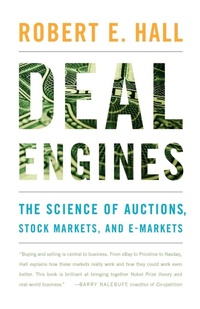
Deal Engines
The Science of Auctions, Stock Markets, and E-Markets
Published on 8. August 2003
Book
Paperback/Softback
240 pages
978-0-393-32467-9 (ISBN)
Description
In Deal Engines, leading economist Robert E. Hall explains the underlying principles of auctions and provides sweeping insight for anyone curious to understand and exploit them. Drawing on decades of research that includes Nobel Prize-winning discoveries, Hall explains that how you set up a market has a lot to do with the deals that result. Moving from examples as straightforward as shopping for a car to others as complex as the mechanisms of stock exchanges, he describes the various types of deal engines that can be used to conduct transactions, including auctions, real-time exchanges, and posted-price sales engines. Hall analyzes the qualities of the markets these deal engines give rise to, with an eye to practical outcomes, and provides invaluable information and guidance to everyone from entrepreneurs working on a business plan to buyers on eBay. Originally published in hardcover under the title Digital Dealing.
Reviews / Votes
"This book is brilliant at bringing together Nobel Prize theory and real-world business." -- Barry Nalebuff, co-author of Co-opetitionMore details
Language
English
Place of publication
New York
United States
Dimensions
Height: 216 mm
Width: 140 mm
Thickness: 14 mm
Weight
344 gr
ISBN-13
978-0-393-32467-9 (9780393324679)
Copyright in bibliographic data and cover images is held by Nielsen Book Services Limited or by the publishers or by their respective licensors: all rights reserved.
Schweitzer Classification
Person
Robert E. Hall received his B.A. from the University of California, Berkeley, and his Ph.D. from the Massachusetts Institute of Technology. He taught at Berkeley and at MIT before going to Stanford. Along with his research and teaching interests, Professor Hall is chairman of the Business Cycles Dating Committee of the National Bureau for Economic Research, which maintains the official chronology of the U.S. business cycle.