

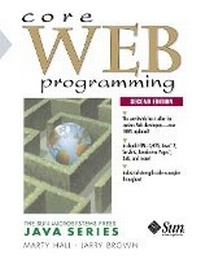
Core Web Programming
2nd Edition
Published on 3. July 2001
Book
Paperback/Softback
1440 pages
978-0-13-089793-0 (ISBN)
Description
Every Web developer needs to understand three core technologies: HTML 4, Java 2/J2EE, and JavaScript. Now, you can learn them all in one book: Core Web Programming, Second Edition, the ultimate Web development resource for experienced programmers! Writing for experienced programmers, Marty Hall begins with detailed, practical coverage of HTML 4 -- from the fundamentals to Cascading Style Sheets, Dynamic HTML, and beyond. Next, Hall shows programmers how to use Java as the base language for Web programming, and integrate other key technologies as needed. Along the way, Hall presents Web-focused coverage of Swing, Java threads, I/O, network programming on both clients and servers, HTTP, servlets, JavaServer Pages, and the latest version of JavaScript -- everything you need to know to build the most effective Web applications possible.
More details
Edition
2nd edition
Language
English
Place of publication
Upper Saddle River
United States
Publishing group
Pearson Education (US)
Target group
College/higher education
Dimensions
Height: 178 mm
Width: 233 mm
Thickness: 50 mm
Weight
2186 gr
ISBN-13
978-0-13-089793-0 (9780130897930)
Schweitzer Classification
Other editions
Previous edition
Persons
MARTY HALL is the author of Core Servlets and JavaServer Pages, the world's most popular book on servlet and JSP technology. He is a Senior Computer Scientist at the Johns Hopkins University Applied Physics Laboratory.
LARRY BROWN is a Senior Network Engineer at the Naval Sea Systems Command, Carderock Division. He is also a Computer Science faculty member at the Johns Hopkins University, where he teaches server-side programming, distributed Web programming, and Java user interface development for the part-time graduate program in Computer Science.
LARRY BROWN is a Senior Network Engineer at the Naval Sea Systems Command, Carderock Division. He is also a Computer Science faculty member at the Johns Hopkins University, where he teaches server-side programming, distributed Web programming, and Java user interface development for the part-time graduate program in Computer Science.
Content
Introduction.
Acknowledgments.
I. THE HYPERTEXT MARKUP LANGUAGE.
1. Designing Web Pages with HTML 4.0.
2. Block-Level Elements in HTML 4.0.
3. Text-Level Elements in HTML 4.0.
4. Frames.
5. Cascading Style Sheets.
II. JAVA PROGRAMMING.
6. Getting Started with Java.
7. Object-Oriented Programming in Java.
8. Basic Java Syntax.
9. Applets and Basic Graphics.
10. Java 2D: Graphics in Java 2.
11. Handling Mouse and Keyboard Events.
12. Layout Managers.
13. AWT Components.
14. Basic Swing.
15. Advanced Swing.
16. Concurrent Programming with Java Threads.
17. Network Programming.
III. SERVER-SIDE PROGRAMMING.
18. HTML Forms.
19. Server-Side Java Servlets.
20. Javaserver Pages.
21. Using Applets as Front Ends to Server-Side Programs.
22. JDBC.
23. XML Processing with Java.
IV. JAVASCRIPT.
24. JavaScript: Adding Dynamic Content to Web Pages.
25. JavaScript Quick Reference.
Index.
Acknowledgments.
I. THE HYPERTEXT MARKUP LANGUAGE.
1. Designing Web Pages with HTML 4.0.
2. Block-Level Elements in HTML 4.0.
3. Text-Level Elements in HTML 4.0.
4. Frames.
5. Cascading Style Sheets.
II. JAVA PROGRAMMING.
6. Getting Started with Java.
7. Object-Oriented Programming in Java.
8. Basic Java Syntax.
9. Applets and Basic Graphics.
10. Java 2D: Graphics in Java 2.
11. Handling Mouse and Keyboard Events.
12. Layout Managers.
13. AWT Components.
14. Basic Swing.
15. Advanced Swing.
16. Concurrent Programming with Java Threads.
17. Network Programming.
III. SERVER-SIDE PROGRAMMING.
18. HTML Forms.
19. Server-Side Java Servlets.
20. Javaserver Pages.
21. Using Applets as Front Ends to Server-Side Programs.
22. JDBC.
23. XML Processing with Java.
IV. JAVASCRIPT.
24. JavaScript: Adding Dynamic Content to Web Pages.
25. JavaScript Quick Reference.
Index.