

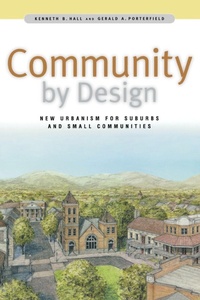
Community By Design: New Urbanism for Suburbs and Small Communities
New Urbanism for Suburbs and Small Communities
Will be published approx. on 16. April 2001
Book
Hardback
296 pages
978-0-07-134523-1 (ISBN)
Description
More than 50 per cent of Americans live in suburban and exurban communities, and populations are increasing as more people seek green spaces, better access to education, retirement living, and homeownership. Yet these communities, with smaller budgets and no long-term growth planning, are unprepared for the problems - traffic congestion, poor air quality, and strip malls, to name a few - that are now plaguing them. "Community by Design", authored by two specialists in suburban and exurban design and development, shows how to apply good planning practices to these smaller communities.
Reviews / Votes
The suburban landscape of the United States - the all-too-familiar array of fast-food franchise, big-box retail stores, parking lots, and clogged arterials - the subject of Hall and Porterfield's book. ... Guided by the principles of the Congress for the New Urbanism (CNU), the authors use excerpts from that organization's charter to illuminate their advocacy of more connected development patterns. The book's scope extends beyond the commercial strip to include the major building blocks of towns and suburbs suck as apartment complexes, schools, parks, and office campuses. ... One ideal audience for this book might be suburban planning commissioners, who need guidance from designers in order to understand the differences between conventional suburban development pods and walkable human-scale neighborhoods. The many black and white photographs of completed projects are helpful in this regard. ... Journal of the American Planning Association 20030701 by William A. Green, ASLA[Community by Design] was written for professionals, politicians, and citizens "taking an active role...and for those who are not yet part of the process but who want to know what it's about."Part 1, "Parts of the Puzzle," provides the reader with background on a variety of important topics and tools. In Chapter 1, "What is Community Design, Anyway?" the authors introduce basic definitions of neighborhood and community, present the building blocks of community design, and offer a description of spatial components and some of the community designer's tools.In "Putting It All Together" [Part 2], each chapter contains information focused on community design issues. With chapter titles including "Where Would You Rather Live?" and variants "...Shop?",...Work?",...Relax?", the authors present material that is well organized, clear, and accessible. In each chapter they describe pertinent issues, present patterns of development found in conventional suburban developments (those built after World War II), and offer alternatives from traditional neighborhood developments or those developments that are often found in older communities. Each chapter emphasizes some of the choices we have when designing communities as places for living, shopping, working, and relaxing. This comparative format works effectively.For illustration, the authors provide black-and-white photos, descriptive plans, and project profiles...Community by Design...provide[s] valuable information that...can provide planners, designers, and citizens with information for making more educated community design decisions. Landscape Architecture 20011201More details
Language
English
Place of publication
United States
Publishing group
McGraw-Hill Education - Europe
Target group
College/higher education
Illustrations
258 Illustrations
Dimensions
Height: 260 mm
Width: 183 mm
Thickness: 22 mm
Weight
799 gr
ISBN-13
978-0-07-134523-1 (9780071345231)
Copyright in bibliographic data and cover images is held by Nielsen Book Services Limited or by the publishers or by their respective licensors: all rights reserved.
Schweitzer Classification
Other editions
Additional editions
Kenneth Hall | Gerald Porterfield
Community By Design: New Urbanism for Suburbs and Small Communities
E-Book
04/2001
1st Edition
McGraw-Hill Education
€94.97
Available for download
Persons
Kenneth B. Hall, Jr. ASLA is a landscape architect with the award-winning firm Hanbury Evans Newill Vlattas & Company in Norfolk, Virginia where he specializes in community planning. He holds a B.S. in history from the University of Montevallo and a master's in landscape architecture from Virginia Tech. He has published a variety of articles focusing on issues related to community design. He is a member of the American Society of Landscape Architects and the Congress for New Urbanism.
Gerald A. Porterfield is the President of the Porterfield Design Center based in Chesapeake, Virginia. He holds a B.S. in Landscape Architecture from West Virginia University and is a member of the Urban Land Institute as well as the American Planning Association. He is a frequent speaker on land development issues. Gerald A. Porterfield is the President of the Porterfield Design Center based in Chesapeake, Virginia. He holds a B.S. in Landscape Architecture from West Virginia University and is a member of the Urban Land Institute as well as the American Planning Association. He is a frequent speaker on land development issues.
Gerald A. Porterfield is the President of the Porterfield Design Center based in Chesapeake, Virginia. He holds a B.S. in Landscape Architecture from West Virginia University and is a member of the Urban Land Institute as well as the American Planning Association. He is a frequent speaker on land development issues. Gerald A. Porterfield is the President of the Porterfield Design Center based in Chesapeake, Virginia. He holds a B.S. in Landscape Architecture from West Virginia University and is a member of the Urban Land Institute as well as the American Planning Association. He is a frequent speaker on land development issues.
Content
Part 1: Parts of the Puzzle. Chapter 1: What is Community Design, Anyway? Chapter 2: What's the Process of Community Design? Chapter 3: What Is the Language of Design. Chapter 4: What Is the Framework of Community? Part 2: Putting It All Together. Chapter 5: Where Would You Rather Live? Chapter 6: Where Would You Rather Shop? Chapter 7: Where Would You Rather Work? Chapter 8: Where Would You Rather Relax? Chapter 9: Learning How to Put It All Together.