

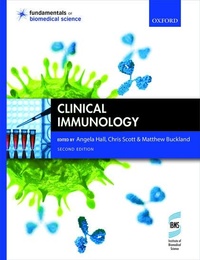
Clinical Immunology
2nd Edition
Published on 10. March 2016
Book
Paperback/Softback
360 pages
978-0-19-965765-0 (ISBN)
Description
Biomedical scientists are the foundation of modern healthcare, from cancer screening to diagnosing HIV, from blood transfusion for surgery to food poisoning and infection control. Without biomedical scientists, the diagnosis of disease, the evaluation of the effectiveness of treatment, and research into the causes and cures of disease would not be possible.
The Fundamentals of Biomedical Science series has been written to reflect the challenges of practicing biomedical science today. It draws together essential basic science with insights into laboratory practice to show how an understanding of the biology of disease is coupled to the analytical approaches that lead to diagnosis.
Assuming only a minimum of prior knowledge, the series reviews the full range of disciplines to which a Biomedical Scientist may be exposed - from microbiology to cytopathology to transfusion science.
Clinical Immunology gives the new biomedical scientist an insight into the function of the immune system, the front line of defence against pathological disease, and the diagnostic techniques used to identify associated malfunctions and disorders. By examining the key immunological principles and scientific basis of laboratory techniques with a focus on the biomedical scientist's role in the diagnostic laboratory, the reader is provided with everything needed to prepare for a specialist qualification in immunology. Current tests, the rationale behind their use, the technologies employed, and the quality measures applied are illustrated by specific case studies showing how the clinician interprets the results to help the patient.
Online Resource Centre
The Online Resource Centre to accompany Clinical Immunology features:
For registered adopters of the book:
- Figures from the book, available to download
For students:
- Answers to self-check and end of chapter questions
- Video podcasts including interviews with practicing biomedical scientists and 'in the lab' footage showing biomedical science in practice
The Fundamentals of Biomedical Science series has been written to reflect the challenges of practicing biomedical science today. It draws together essential basic science with insights into laboratory practice to show how an understanding of the biology of disease is coupled to the analytical approaches that lead to diagnosis.
Assuming only a minimum of prior knowledge, the series reviews the full range of disciplines to which a Biomedical Scientist may be exposed - from microbiology to cytopathology to transfusion science.
Clinical Immunology gives the new biomedical scientist an insight into the function of the immune system, the front line of defence against pathological disease, and the diagnostic techniques used to identify associated malfunctions and disorders. By examining the key immunological principles and scientific basis of laboratory techniques with a focus on the biomedical scientist's role in the diagnostic laboratory, the reader is provided with everything needed to prepare for a specialist qualification in immunology. Current tests, the rationale behind their use, the technologies employed, and the quality measures applied are illustrated by specific case studies showing how the clinician interprets the results to help the patient.
Online Resource Centre
The Online Resource Centre to accompany Clinical Immunology features:
For registered adopters of the book:
- Figures from the book, available to download
For students:
- Answers to self-check and end of chapter questions
- Video podcasts including interviews with practicing biomedical scientists and 'in the lab' footage showing biomedical science in practice
Reviews / Votes
Review from previous edition The main strength is the description of the methods used in a laboratory setting. This is a unique feature and makes it stand out from other textbooks in the area. * Dr Fiona L. Henriquez, University of the West of Scotland * Using case studies really helps to integrate knowledge in an applied context. Students not only get to understand what is happening, but they begin to see why this is important, how this can affect the patient, and what it could mean to them in the diagnostic laboratory. * Glenn Hussey, Keele University * This excellent book would be particularly useful for undergraduates aiming to enter a career in biomedical science, and also a worthwhile read for trainee and practising biomedical scientists. * Immunology News *More details
Series
Edition
2nd Revised edition
Language
English
Place of publication
Oxford
United Kingdom
Target group
Professional and scholarly
Edition type
Revised edition
Illustrations
85 line illustrations and 60 halftones
Dimensions
Height: 246 mm
Width: 187 mm
Thickness: 20 mm
Weight
684 gr
ISBN-13
978-0-19-965765-0 (9780199657650)
Copyright in bibliographic data and cover images is held by Nielsen Book Services Limited or by the publishers or by their respective licensors: all rights reserved.
Schweitzer Classification
Other editions
Previous edition
Angela Hall | Christine Yates
Immunology
Book
06/2010
1st Edition
Oxford University Press
€39.67
Article exhausted; check for reprint
Persons
Angela Hall, CSci FIBMS, Laboratory Manager, Department of Infection and Immunity, Imperial College Healthcare NHS Trust, Christopher Baldwin, Head of the School of Biomedical Sciences, Newcastle University
Content
1. Introduction to the clinical immunology laboratory ; 2. Immunoglobulins ; 3. Allergy ; 4. Complement ; 5. Autoimmune rheumatological disease ; 6. Autoimmune kidney disease ; 7. Organ specific autoimmunity ; 8. Autoimmune skin disorders ; 9. Autoimmune liver disease ; 10. Neuroimmunology ; 11. Flow cytometry and primary immunodeficiency ; 12. Human immunodeficiency virus (HIV) ; 13. Histocompatibility and immunogenetics