

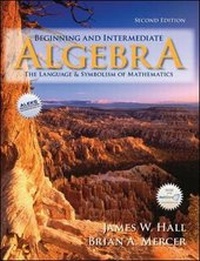
Beginning and Intermediate Algebra
2nd Edition
Published on 16. March 2007
Book
Hardback
976 pages
978-0-07-322971-3 (ISBN)
Description
Intended for schools that want a single text covering the standard topics from Beginning and Intermediate Algebra. Topics are organized by using the principles of the AMATYC standards as a guide, giving strong support to teachers using the text. The book's organization and pedagogy are designed to work for students with a variety of learning styles and for teachers with varied experiences and backgrounds. The inclusion of multiple perspectives -- verbal, numerical, algebraic, and graphical -- has proven popular with a broad cross section of students. Use of a graphing calculator is assumed. BEGINNING AND INTERMEDIATE ALGEBRA: THE LANGUAGE AND SYMBOLISM OF MATHEMATICS is a reform-oriented book.
More details
Edition
2nd edition
Language
English
Place of publication
United States
Publishing group
McGraw-Hill Education - Europe
Dimensions
Height: 285 mm
Width: 221 mm
Thickness: 40 mm
Weight
2377 gr
ISBN-13
978-0-07-322971-3 (9780073229713)
Copyright in bibliographic data and cover images is held by Nielsen Book Services Limited or by the publishers or by their respective licensors: all rights reserved.
Schweitzer Classification
Other editions
Previous edition
James W. Hall | Brian A. Mercer
Beginning and Intermediate Algebra: With OLC and SMART CD
Book
08/2002
McGraw-Hill Inc.,US
€94.34
Article exhausted; check for reprint
Persons
JAMES W. HALL B.S. and M.A. in mathematics from Eastern Illinois University and Ed.D. from
Oklahoma State University 35 years teaching college mathematics with 31 years in the community college system
Chair of the Mathematics Department at Parkland College in Champaign, Illinois, for 7 years
Author of 19 mathematics books in developmental education
Member of AMATYC (American Mathematical Association for Two-Year Colleges) for 34 years, Midwest Regional Vice President 19871989, chair of the editorial review committee 19911995, and writing team chair for Chapter 6 on Curriculum and Program Development of Beyond Crossroads.
President of IMACC (Illinois Mathematics Association of Community Colleges) 19951996
My wife and I enjoy traveling and seeing the wonders of the world, both natural and man-made.
I can say without a doubt that I was made to be in a classroom. I followed the footsteps of my father, a 35-year middle school math teaching veteran, into this challenging yet rewarding career. My college experience began as a community college student at Lakeland College in Mattoon, Illinois. From there, I received a Bachelor of Science in Mathematics from Eastern Illinois University and a Master of Science in Mathematics from Southern Illinois University. I accepted a tenure-track faculty position at Parkland College, where I have taught developmental and college-level courses for 15 years. I had the opportunity to begin writing textbooks shortly after I started teaching at Parkland. My then department chair and mentor, James W. Hall, and I co-authored several textbooks in Beginning and Intermediate Algebra. In the fall of 2011, our department began discussing the idea of creating two tracks through our beginning and intermediate algebra courses. The idea stemmed from two issues. First, most of our beginning and intermediate algebra students were headed to either our Liberal Arts Math or our Introduction to Statistics course. Second, we wanted to beef up intermediate algebra to better prepare those students who were headed to college algebra. These were two competing ideas! Increasing the algebraic rigor of these courses seemed to punish students who were not heading to college algebra. With the two track system, we implemented a solution that best serves both groups of students. I have to admit that I was initially concerned that offering an alternate path through developmental mathematics for students not planning to take college algebra would lead to a lowering of standards. However, my participation in our committee investigating this idea led me to believe it was possible to offer a rigorous course that was exceedingly more appropriate for this group of students. Since there were no materials for the course, I began creating my own and was paired by McGraw Hill with Dave Sobecki. Together, we have created the material that I have been using for class testing. After a semester and a half of piloting these materials and seeing the level of enthusiasm and engagement in the mathematical conversations of my students, I am now convinced that this is an ideal course to refine and offer. As a trusted colleague told me, this is just a long overdue idea. Outside of the classroom and away from the computer, I am kept educated, entertained and ever-busy my wonderful wife, Nikki, and our two children, Charlotte, 6 and Jake, 5. I am an avid St. Louis Cardinals fan and enjoy playing recreational softball and golf in the summertime with colleagues and friends.
Oklahoma State University 35 years teaching college mathematics with 31 years in the community college system
Chair of the Mathematics Department at Parkland College in Champaign, Illinois, for 7 years
Author of 19 mathematics books in developmental education
Member of AMATYC (American Mathematical Association for Two-Year Colleges) for 34 years, Midwest Regional Vice President 19871989, chair of the editorial review committee 19911995, and writing team chair for Chapter 6 on Curriculum and Program Development of Beyond Crossroads.
President of IMACC (Illinois Mathematics Association of Community Colleges) 19951996
My wife and I enjoy traveling and seeing the wonders of the world, both natural and man-made.
I can say without a doubt that I was made to be in a classroom. I followed the footsteps of my father, a 35-year middle school math teaching veteran, into this challenging yet rewarding career. My college experience began as a community college student at Lakeland College in Mattoon, Illinois. From there, I received a Bachelor of Science in Mathematics from Eastern Illinois University and a Master of Science in Mathematics from Southern Illinois University. I accepted a tenure-track faculty position at Parkland College, where I have taught developmental and college-level courses for 15 years. I had the opportunity to begin writing textbooks shortly after I started teaching at Parkland. My then department chair and mentor, James W. Hall, and I co-authored several textbooks in Beginning and Intermediate Algebra. In the fall of 2011, our department began discussing the idea of creating two tracks through our beginning and intermediate algebra courses. The idea stemmed from two issues. First, most of our beginning and intermediate algebra students were headed to either our Liberal Arts Math or our Introduction to Statistics course. Second, we wanted to beef up intermediate algebra to better prepare those students who were headed to college algebra. These were two competing ideas! Increasing the algebraic rigor of these courses seemed to punish students who were not heading to college algebra. With the two track system, we implemented a solution that best serves both groups of students. I have to admit that I was initially concerned that offering an alternate path through developmental mathematics for students not planning to take college algebra would lead to a lowering of standards. However, my participation in our committee investigating this idea led me to believe it was possible to offer a rigorous course that was exceedingly more appropriate for this group of students. Since there were no materials for the course, I began creating my own and was paired by McGraw Hill with Dave Sobecki. Together, we have created the material that I have been using for class testing. After a semester and a half of piloting these materials and seeing the level of enthusiasm and engagement in the mathematical conversations of my students, I am now convinced that this is an ideal course to refine and offer. As a trusted colleague told me, this is just a long overdue idea. Outside of the classroom and away from the computer, I am kept educated, entertained and ever-busy my wonderful wife, Nikki, and our two children, Charlotte, 6 and Jake, 5. I am an avid St. Louis Cardinals fan and enjoy playing recreational softball and golf in the summertime with colleagues and friends.
Content
1 Operations with Real Numbers 1.1 Preparing for an Algebra Class 1.2 The Real Number Line 1.3 Addition of Real Numbers 1.4 Subtraction of Real Numbers 1.5 Multiplication of Real Numbers and Natural Number Exponents 1.6 Division of Real Numbers 1.7 Order of Operations 2 Linear Equations and Patterns 2.1 The Rectangular Coordinate System and Arithmetic Sequences 2.2 Function Notation and Linear Functions 2.3 Graphs of Linear Equations in Two Variables 2.4 Solving Linear Equations in One Variable by Using the Addition-Subtraction Principle 2.5 Solving Linear Equations in One Variable by Using the Multiplication-Division Principle 2.6 Using and Rearranging Formulas 2.7 Proportions and Direct Variation 2.8 More Applications of Linear Equations 3 Lines and Systems of Linear Equations in Two Variables 3.1 Slope of a Line and Applications of Slope 3.2 Special Forms of Linear Equations in Two Variables 3.3 Solving Systems of Linear Equations in Two Variables Graphically and Numerically 3.4 Solving Systems of Linear Equations in Two Variables by the Substitution Method 3.5 Solving Systems of Linear Equations in Two Variables by the Addition Method 3.6 More Applications of Linear Systems Cumulative Review of Chapters 1-3 4 Linear Inequalities and Systems of Linear Inequalities 4.1 Solving Linear Inequalities by Using the Addition-Subtraction Principle 4.2 Solving Linear Inequalities by Using the Multiplication-Divison Principle 4.3 Solving Compound Inequalities 4.4 Solving Absolute Value Equations and Inequalities 4.5 Graphing Systems of Linear Inequalities in Two Variables 5 Exponents and Operations with Polynomials 5.1 Product and Power Rules for Exponents 5.2 Quotient Rule and Zero Exponents 5.3 Negative Exponents and Scientific Notation 5.4 Adding and Subtracting Polynomials 5.5 Multiplying Polynomials 5.6 Special Products of Binomials 5.7 Dividing Polynomials Diagonostic Review of Beginning Algebra 6 Factoring Polynomials 6.1 An Introduction to Factoring Polynomials 6.2 Factoring Trinomials of the Form x2 + bxy + cy2 6.3 Factoring Trinomials of the Form ax2 + bxy + cy2 6.4 Factoring Special Forms 6.5 Factoring by Grouping and a General Strategy for Factoring Polynomials 6.6 Solving Equations by Factoring 7 Functions: Linear, Absolute Value, and Quadratic 7.1 Functions and Representations of Functions 7.2 Linear and Absolute Value Functions 7.3 Linear and Quadratic Functions and Curve Fitting 7.4 Using the Quadratic Formula to find Real Solutions 7.5 The Vertex of a Parabola and Max-Min Applications 7.6 More Applications of Quadratic Equations 7.7 Complex Numbers and Solving Quadratic Equations with Complex Solutions 8 Rational Functions 8.1 Graphs of Rational Functions and Reducing Rational Expressions 8.2 Multiplying and Dividing Rational Expressions 8.3 Adding and Subtracting Rational Expressions 8.4 Combining Operations and Simplifying Complex Rational Expressions 8.5 Solving Equations Containing Rational Expressions 8.6 Inverse and Joint Variation and Other Applications Yielding Equations with Fractions Cumulative Review of Chapters 1-8 9 Square Root and Cube Root Functions and Rational Exponents 9.1 Evaluating Radical Expressions and Graphs of Square Root and Cube Root Functions 9.2 Adding and Subtracting Radical Expressions 9.3 Multiplying and Dividing Radical Expressions 9.4 Solving Equations Containing Radical Expressions 9.5 Rational Exponents and Radicals 10 Exponential and Logarithmic Functions 10.1 Geometric Sequences Graphs of Exponential Functions 10.2 Inverse Functions 10.3 Logarithmic Functions 10.4 Evaluating Logarithms 10.5 Properties of Logarithms 10.6 Solving Exponential and Logarithmic Equations 10.7 Exponential Curve Fitting and Other Applications of Exponential and Logarithmic Equations Cumulative Review of Chapters 1-10 11 A Preview of College Algebra 11.1 Solving Systems of Linear Equations by Using Augmented Matrices 11.2 Systems of Linear Equations in Three Variables 11.3 Horizontal and Vertical Translations of the Graphs of Functions 11.4 Stretching, Shrinking and Reflecting Graphs of Functions 11.5 Algebra of Functions 11.6 Sequences, Series and Summation Notation 11.7 Conic Sections