

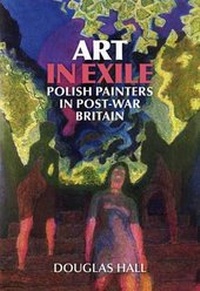
Art in Exile
Polish Painters in Post-War Britain
Published on 1. February 2008
Book
Paperback/Softback
400 pages
978-1-904537-66-3 (ISBN)
Description
This book is about a body of painters who have generally been marginalised by British art historians - the Polish exiles from war and persecution who made their homes and careers in Britain before or after 1939. It takes ten of them, explores their origins, their often hazardous escape from occupied Europe, their reception and the development of their work. Some who were personally known to the author, such as Herman and Ruszkowski, are, along with Gotlib and others, the subject of searching enquiry; a further group, perhaps better known, like Adler and Potworowski, are also covered. The book has chapters on the Polish context from which they came, on the problems East European art has encountered in the West, and on the Polish artistic community in Britain as a whole. The author Douglas Hall, who was the first Keeper of the Scottish National Gallery of Modern Art and still lives in Scotland, is known for his sympathy with the underdog and his interest in unfashionable or belittled values and modes of expression in modern art. The appearance of this book is timely. Since the author first began to study the subject the perception of Poland in Britain has changed utterly.
Further integration of Poland into the European community should lead to further exchanges of art between the two countries. If it does not, it may not be for economic reasons alone, but may be further evidence of the reluctance of Western art authorities to take East European art, as a whole, seriously. The book suggests a beginning in better understanding by starting with those Poles who became British, and whose work for the most part is still here, a part of British art that is for ever Polish.
Further integration of Poland into the European community should lead to further exchanges of art between the two countries. If it does not, it may not be for economic reasons alone, but may be further evidence of the reluctance of Western art authorities to take East European art, as a whole, seriously. The book suggests a beginning in better understanding by starting with those Poles who became British, and whose work for the most part is still here, a part of British art that is for ever Polish.
More details
Language
English
Place of publication
United Kingdom
Publishing group
Sansom & Co
Illustrations
100 colour, 50 mono
Dimensions
Height: 244 mm
Width: 172 mm
ISBN-13
978-1-904537-66-3 (9781904537663)
Copyright in bibliographic data and cover images is held by Nielsen Book Services Limited or by the publishers or by their respective licensors: all rights reserved.
Schweitzer Classification
Person
Douglas Hall, OBE BA FMA, was born in London of Scottish parents in 1926. After war service from 1944 to 1948, he graduated from the Courtauld Institute in 1952, and immediately entered the museum profession as Keeper of the Rutherston Collection at Manchester City Art Galleries, becoming Deputy Director in 1958. After the opening of the infant Scottish National Gallery of Modern Art in 1960, he became its first Keeper in 1961, a post he retained until retiring in 1986.From the outset Hall faced many contradictory circumstances. The 60s decade, the beginning of the revolution in contemporary art, might have suggested a purely avant-garde museum on a German model. The Trustees, who saw the Gallery as a forward extension of the National Gallery of Scotland, took a different view. In early years shortage of staff, comparative isolation and low funding for travel, exhibitions and acquisitions greatly restricted activity. With the gradual relaxation of these limitations the foundations of the great collection of today were laid and seeds sown that later blossomed into massive gifts and bequests and the expansion into the fine pair of buildings that house the Gallery today.By both necessity and inclination Douglas Hall steered a line between the avant-garde fervour of some colleagues elsewhere and the conservatism of the Scottish art establishment. Hostile to attributing celebrity and cult status to artists, he pursued some unfashionable interests. His interest in the Polish emigres stemmed partly from this, partly from the well-remembered Polish army presence in Scotland during the war. Hall's non-partisan history makes him a proper advocate for marginalised artists of any kind.
Content
ContentsAcknowledgementsIntroductoryPrefaceOn the Reception of Modern Art from Central and Eastern Europe in the WestThe Polish ContextAdapting to Exile: Six Case StudiesHenryk Gotlib 1890-1966Aleksander yw 1905-1999Marian Kratochwil 1906-1997Zdzislaw Ruszkowski 1907-1991Josef Herman 1911-2000Stanislaw Frenkiel 1918-2001Polish Artists in Britain: A Wider ViewPoles in Scotland and LondonJankel Adler 1895-1949Marian Bohusz-Szysko 1901-1995Marek Zulawski 1908-1995ConclusionFurther ReadingIndex