

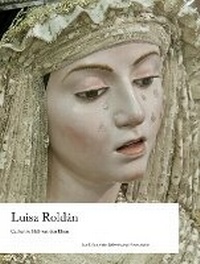
Luisa Roldan
Published on 1. September 2021
Book
Hardback
144 pages
978-1-84822-446-9 (ISBN)
Description
This beautifully illustrated monograph presents the first overview in English of the life and work of Luisa Roldan (1652-1706), a prolific and celebrated sculptor of the Spanish Golden Age.
The daughter of Pedro Roldan, a well-known sculptor from Seville, she developed her talent in her father's workshop. Early in her career she produced large polychromed wooden sculptures for churches in Seville, Cadiz, and surrounding towns. She spent the second half of her career in Madrid, where she worked in both polychromed wood and polychromed terracotta, developing new products for a domestic, devotional market. In recognition of her talent, she was awarded the title of Sculptor to the Royal Chambers of two kings of Spain, Charles II and Philip V.
This book places Roldan within a wider historical and social context, exploring what life would have been like for her as a woman sculptor in early modern Spain. It considers her work alongside that of other artists of the Baroque period, including Velazquez, Murillo, and Zurbaran. Reflecting on the opportunities available to her during this time, as well as the challenges she faced, Catherine Hall-van den Elsen weaves the narrative of Roldan's story with analysis, revealing the complexities of her oeuvre.
Every year, newly discovered sculptures in wood and in terracotta enter into Roldan's oeuvre. As her artistic output begins to attract greater attention from scholars and art lovers, Luisa Roldan provides invaluable insights into her artistic achievements.
The daughter of Pedro Roldan, a well-known sculptor from Seville, she developed her talent in her father's workshop. Early in her career she produced large polychromed wooden sculptures for churches in Seville, Cadiz, and surrounding towns. She spent the second half of her career in Madrid, where she worked in both polychromed wood and polychromed terracotta, developing new products for a domestic, devotional market. In recognition of her talent, she was awarded the title of Sculptor to the Royal Chambers of two kings of Spain, Charles II and Philip V.
This book places Roldan within a wider historical and social context, exploring what life would have been like for her as a woman sculptor in early modern Spain. It considers her work alongside that of other artists of the Baroque period, including Velazquez, Murillo, and Zurbaran. Reflecting on the opportunities available to her during this time, as well as the challenges she faced, Catherine Hall-van den Elsen weaves the narrative of Roldan's story with analysis, revealing the complexities of her oeuvre.
Every year, newly discovered sculptures in wood and in terracotta enter into Roldan's oeuvre. As her artistic output begins to attract greater attention from scholars and art lovers, Luisa Roldan provides invaluable insights into her artistic achievements.
Reviews / Votes
'An invaluable introduction to the figure of Luisa Roldan . . . Drawing on her own extensive archival research and decades of firsthand study of the sculpture, Catherine Hall-van den Elsen offers a sensitive analysis of the works while also setting them effectively in their historical context . . . More than the story of one remarkable sculptor, this book also offers insights into the challenges women confronted in seventeenth-century Spain and the artistic production of the period.' - Patrick Lenaghan, Curator, Hispanic Society Museum and Library 'Catherine Hall has produced a book which is a pleasure to read, superbly illustrated, incorporating fascinating details about the society in which Luisa worked, including the challenges she faced as a woman artist. At the same time this monograph is rooted in serious scholarship, discussing the process of some of the commissions, as well as the materials and techniques lying behind the creation of these extraordinary works of art. This is both a highly readable and delightful book.' - Marjorie Trusted, Honorary Senior Research Fellow, Victoria and Albert Museum 'Luisa Roldan's story is full of paradoxes. Despite her success she died in penury. She was remembered as 'an immortal' by the early 18th-century art historian Antonio Palomino but was not the subject of a solo exhibition until 2007. Hall-van den Elsen's monograph makes an important contribution to the existing bibliography, only some of which is included at the back of the book, and to raising the profile of Roldan's enchanting terracottas, which deserve a catalogue all of their own.' - Apollo magazine 'There is much here to counteract the minority-interest category that Spanish Baroque polychromed sculpture might still be shelved under by many. The high-quality illustrations make the publication attractive and enable useful study of the materials, techniques, and development of the sculptor's style. Above all, they show the refinement and delicacy of her art. The writing is clear and flows naturally, making the book remarkably accessible.' - Hilary Macartney, CAA ReviewsMore details
Series
Language
English
Place of publication
London
United Kingdom
Illustrations
83 Illustrations, color; 4 Illustrations, black and white
Dimensions
Height: 250 mm
Width: 190 mm
ISBN-13
978-1-84822-446-9 (9781848224469)
Copyright in bibliographic data and cover images is held by Nielsen Book Services Limited or by the publishers or by their respective licensors: all rights reserved.
Schweitzer Classification
Person
Catherine Hall-van den Elsen studied Spanish art at La Trobe University in Melbourne, Australia. She completed her M.A (1986) and Ph.D (1992) on the life and work of Luisa Roldan. In 2018, Hall published a monograph of Luisa Roldan in Spanish (Consejo Superior de Investigaciones Cientificas) and in 2020 an annotated bibliography in the Oxford Bibliographies in Art History series (Oxford University Press). She has contributed book chapters to Roldana (Junta de Andalucia, 2007), Women Artists in the Courts of Europe (Amsterdam University Press, anticipated 2021), and Polychromy in the Early Modern World: 1200-1800 (Routledge, anticipated 2022).
Content
Foreword; Introduction; Chapter 1: Women in Early Modern Spain; Chapter 2: Sculpture in Seville; Chapter 3: Andalucia: Building a Career; Chapter 4: Madrid: Challenge and Opportunity; Chapter 5: Luisa Roldan through the lenses of History; notes; chronology; extant works; further reading