

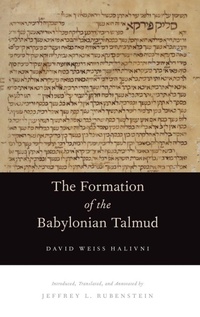
The Formation of the Babylonian Talmud
Published on 19. September 2013
Book
Hardback
350 pages
978-0-19-973988-2 (ISBN)
Description
Jeffrey L. Rubenstein offers a translation from the Hebrew of The Formation of the Babylonian Talmud by David Weiss Halivni. Halivni's work is widely regarded as the most comprehensive scholarly examination of the processes of composition and editing of the Babylonian Talmud.
Halivni presents the summation of a lifetime of scholarship and the conclusions of his multivolume Talmudic commentary, Sources and Traditions (Meqorot umesorot). Arguing against the traditional view that the Talmud was composed c. 450 CE by the last of the named sages in the Talmud, the Amoraim, Halivni proposes that its formation took place over a much longer period of time, not reaching its final form until about 750 CE. The Talmud consists of many literary strata or layers, with later layers constantly commenting upon and reinterpreting earlier layers. The later layers differ qualitatively from the earlier layers, and were composed by anonymous sages whom Halivni calls Stammaim. These sages were the true author-editors of the Talmud, who reconstructed the reasons underpinning earlier rulings, created the dialectical argumentation characteristic of the Talmud, and formulated the literary units that make up the Talmudic text.
Halivni also discusses the history and development of rabbinic tradition from the Mishnah through the post-Talmud legal codes, the types of dialectical analysis found in the different rabbinic works, and the roles of reciters, transmitters, compilers, and editors in the composition of the Talmud. This volume contains an introduction and annotations by Jeffrey Rubenstein.
Halivni presents the summation of a lifetime of scholarship and the conclusions of his multivolume Talmudic commentary, Sources and Traditions (Meqorot umesorot). Arguing against the traditional view that the Talmud was composed c. 450 CE by the last of the named sages in the Talmud, the Amoraim, Halivni proposes that its formation took place over a much longer period of time, not reaching its final form until about 750 CE. The Talmud consists of many literary strata or layers, with later layers constantly commenting upon and reinterpreting earlier layers. The later layers differ qualitatively from the earlier layers, and were composed by anonymous sages whom Halivni calls Stammaim. These sages were the true author-editors of the Talmud, who reconstructed the reasons underpinning earlier rulings, created the dialectical argumentation characteristic of the Talmud, and formulated the literary units that make up the Talmudic text.
Halivni also discusses the history and development of rabbinic tradition from the Mishnah through the post-Talmud legal codes, the types of dialectical analysis found in the different rabbinic works, and the roles of reciters, transmitters, compilers, and editors in the composition of the Talmud. This volume contains an introduction and annotations by Jeffrey Rubenstein.
Reviews / Votes
Rubenstein's translation and editing make this classic work of rabbinic scholarship available for study in English-speaking academic contexts. The book can be highly recommended for advanced students and scholars of rabbinic literature who are reasonably familiar with the Babylonian Talmud itself. * Catherine Hezser, Journal of Jewish Studies *More details
Language
English
Place of publication
New York
United States
Target group
College/higher education
Dimensions
Height: 240 mm
Width: 161 mm
Thickness: 23 mm
Weight
690 gr
ISBN-13
978-0-19-973988-2 (9780199739882)
Copyright in bibliographic data and cover images is held by Nielsen Book Services Limited or by the publishers or by their respective licensors: all rights reserved.
Schweitzer Classification
Other editions
Additional editions
David Weiss Halivni
The Formation of the Babylonian Talmud
E-Book
08/2013
1st Edition
OUP eBook
€67.49
Available for download
David Weiss Halivni
The Formation of the Babylonian Talmud
E-Book
07/2013
1st Edition
OUP eBook
€67.49
Available for download
Persons
DWH: Professor Emeritus of Classical Jewish Civilization, Columbia University. JLR: Skirball Professor of Talmud and Rabbinic Literature, New York University.
Author
Professor Emeritus of Classical Jewish CivilizationProfessor Emeritus of Classical Jewish Civilization, Columbia University, Jerusalem, Israel
Translation
Skirball Professor of Talmud and Rabbinic LiteratureSkirball Professor of Talmud and Rabbinic Literature, New York University, Englewood, NJ
Content
Biography of David Weiss Halivni ; Translation Conventions ; Abbreviations ; Introduction by Jeffrey L. Rubenstein ; Preface ; I: The Stammaim ; II: The Editing of the Talmud ; III: Apodictic Transmission and Dialectical Argumentation ; IV: Compilers and Transposers ; V: Postscript ; Notes ; Annotations ; Selected Bibliography ; General Index ; Source Index