

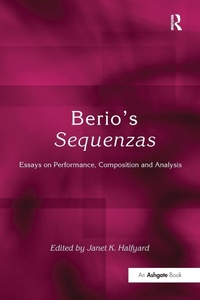
Berio's Sequenzas
Essays on Performance, Composition and Analysis
1st Edition
Published on 11. October 2016
Book
Paperback/Softback
332 pages
978-1-138-24799-4 (ISBN)
Description
Between 1958 and 2002, Luciano Berio wrote fourteen pieces entitled Sequenza, along with several versions of the same work for different instruments, revisions of the original pieces and also the parallel Chemins series, where one of the Sequenzas is used as the basis for a new composition on a larger scale. The Sequenza series is one of the most remarkable achievements of the late twentieth century - a collection of virtuoso pieces that explores the capabilities of a solo instrument and its player, making extreme technical demands of the performer whilst developing the musical vocabulary of the instrument in compositions so assured and so distinctive that each piece both initiates and potentially exhausts the repertoire of a new genre. The Sequenzas have significantly influenced the development of composition for solo instruments and voice, and there is no comparable series of works in the output of any other composer. Series of pieces tend to be linked by the instruments for which the composer writes, but this is a series in which the pieces are linked instead by the variety of instruments for which Berio composed. The varied approaches taken by the contributors in discussing the pieces demonstrate the richness of this repertoire and the many levels on which Berio and these landmark compositions can be considered. Contributions are arranged under three main headings: Performance Issues; Berio's Compositional Process and Aesthetics; and Analytical Approaches.
Reviews / Votes
'... contains much valuable, insightful commentary...' Studies in Musical Theatre '...the first serious contribution to the understanding of this very important part of Berio's compositional output....in addition to these specialist essays covering different aspects of confronting Berio's compositions and abounding in examples from the scores, statistical and graphical respresentation of the research results etc., the book offers an extensive bibliography on Berio and his work, listing of the editions of the Sequenza and the Chemins, a discography register and an index. As such, it surely represents a piece of inevitable literature for experts researching both Berio's work, and composition of the 20th century in general.' International Review of the Sociology and Aesthetics of Music '... a number of musicological fields - solo performance studies, later 20th-century aesthetics, issues of the work-concept - are all the richer for this stimulating volume.' TempoMore details
Language
English
Place of publication
London
United Kingdom
Publishing group
Taylor & Francis Ltd
Target group
College/higher education
Dimensions
Height: 234 mm
Width: 156 mm
Thickness: 18 mm
Weight
509 gr
ISBN-13
978-1-138-24799-4 (9781138247994)
Copyright in bibliographic data and cover images is held by Nielsen Book Services Limited or by the publishers or by their respective licensors: all rights reserved.
Schweitzer Classification
Other editions
Additional editions
E-Book
07/2017
Routledge
€78.99
Available for download
E-Book
07/2017
Routledge
€79.49
Available for download
Book
08/2007
1st Edition
Routledge
€233.80
Shipment within 10-20 days
Person
Janet K. Halfyard is a senior lecturer at UCE Birmingham Conservatoire. Her research includes work on Luciano Berio, Cathy Berberian, extended vocal technique and performance practice issues in contemporary repertoire, and she is active as a performer with the contemporary music ensemble, decibel. Her publications also include work on film and television music: she is the author of Danny Elfman's Batman: a film score guide (2004) in the Scarecrow Press Film Score Guide series and has contributed to European Film Music (2006) in Ashgate's Popular and Folk Music series.
Content
Contents: Foreword; Introduction, David Osmond-Smith. Part 1 Performance Issues: Rhythm and timing in the two versions of Sequenza I for flute solo: psychological and musical differences in performance, Cynthia Folio and Alexander Brinkman; Rough romance: Sequenza II for harp as study and statement, Kirsty Whatley; Phantom rhythms, hidden harmonies: the use of the Sostenuto pedal in Berio's Sequenza IV for piano, leaf and sonata, Zoe Browder Doll; A dress or a straightjacket? Facing the questions of structure and periodicity posed by the notation of Berio's Sequenza VII for oboe, Patricia Alessandrini; Shadow boxing: Sequenza X for trumpet and piano resonance, Jonathan Impett. Part 2 Berio's Compositional Process and Aesthetics: Provoking acts: the theatre of Berio's Sequenzas, Janet K. Halfyard; The Chemins series, Paul Roberts; The compass of communications in Sequenza VIII for violin, Eugene Montague; Sequenza IX for clarinet: text, pre-text, con-text, Andrea Cremaschi; Proliferations and limitations: Beroi's reworking of the Sequenzas, Edward Venn. Part 3 Analytical Approaches: Vestiges of twelve-tone practice as compositional process in Berio's Sequenza I for solo flute, Irna Priore; Sonic complexity and harmonic syntax in Sequenza IV for piano, Didier Guigue and MarcA-lio Fagner Onofre; The nature of expressivity in Berio's Sequenza VI for viola, Amanda Bayley; A polyphonic type of listening in and out of focus: Berio's Sequenza XI for guitar, Mark D. Porcaro; ...and so a chord consoles us: Berio's Sequenza XIII (Chanson) for accordion, Thomas Gartmann. Bibliography; Discography; Index.