

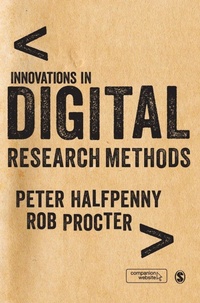
Innovations in Digital Research Methods
1st Edition
Published on 2. June 2015
Book
Hardback
336 pages
978-1-4462-0308-8 (ISBN)
Description
Vast amounts of digital data are now generated daily by people as they go about their lives, yet social researchers are struggling to exploit it. At the same time, the challenges faced by society in the 21st century are growing ever more complex, and demands research that is bigger in scale, more collaborative and multi-disciplinary than ever before.
This cutting-edge volume provides an accessible introduction to innovative digital social research tools and methods that harness this 'data deluge' and successfully tackle key research challenges. Contributions from leading international researchers cover topics such as:
Qualitative, quantitative and mixed methods research
Data management
Social media and social network analysis
Modeling and simulation
Survey methods
Visualizing social data
Ethics and e-research
The future of social research in the digital age
This vibrant introduction to innovative digital research methods is essential reading for anyone conducting social research today.
This cutting-edge volume provides an accessible introduction to innovative digital social research tools and methods that harness this 'data deluge' and successfully tackle key research challenges. Contributions from leading international researchers cover topics such as:
Qualitative, quantitative and mixed methods research
Data management
Social media and social network analysis
Modeling and simulation
Survey methods
Visualizing social data
Ethics and e-research
The future of social research in the digital age
This vibrant introduction to innovative digital research methods is essential reading for anyone conducting social research today.
Reviews / Votes
From machine learning tweets to ethical considerations of Big Data, this timely book provides a highly interdisciplinary survey of innovative digital research methods. The book uniquely blurs qualitative and quantitative approaches to provide refreshingly forward-looking insights for those new to digital research, but also for those more experienced in the field. -- Dhiraj Murthy This very-up-to-date volume provides an accessible introduction to innovative digital social research tools and methods that harness this "data deluge" and successfully tackle key research challenges. It provides a highly interdisciplinary survey of innovative digital research methods and uniquely blurs qualitative and quantitative approaches to provide insights for those new to digital research, but also for those more experienced in the field. Contributions from leading international researchers cover topics such as qualitative, quantitative and mixed methods research, and data management. -- Karl M van Meter Innovations in Digital Research Methods provides a??? timely, insightful survey of eResearch methods. It is an essential title that joins a select few in representing and substantiating digital methods knowledge in our field at this time. -- Sarah LewthwaiteMore details
Edition
First Edition
Language
English
Place of publication
London
United Kingdom
Target group
College/higher education
Professional and scholarly
Dimensions
Height: 250 mm
Width: 175 mm
Thickness: 23 mm
Weight
764 gr
ISBN-13
978-1-4462-0308-8 (9781446203088)
Copyright in bibliographic data and cover images is held by Nielsen Book Services Limited or by the publishers or by their respective licensors: all rights reserved.
Schweitzer Classification
Other editions
Additional editions
Peter Halfpenny | Rob Procter
Innovations in Digital Research Methods
E-Book
06/2015
1st Edition
SAGE Publications Ltd
€94.99
Available for download
Peter Halfpenny | Rob Procter
Innovations in Digital Research Methods
Book
06/2015
1st Edition
SAGE Publications Ltd
€105.30
Shipment within 15-20 days
Peter Halfpenny | Rob Procter
Innovations in Digital Research Methods
E-Book
05/2015
1st Edition
SAGE Publications Ltd
€94.99
Available for download
Persons
Peter Halfpenny is Emeritus Professor of Sociology at the University of Manchester. He was Executive Director of the ESRC National Centre for e-Social Science from 2004 to 2010, responsible for the overall strategic management of the Centre's programme of research, outreach and capacity-building. Peter's own research interests are in the integration of computer tools and services into a comprehensive support environment for social science researcher practitioners, and the investigation of the adoption and adaptation of e-Science tools across the social research community.
Rob Procter is Professor of Social Informatics in the Department of Computer Science, University of Warwick, where he is deputy head of department and research director of the Warwick Institute for the Science of Cities (WISC), and Exchange Professor, NYU. Previously, he was research director of the ESRC National Centre for e-Social Science, where he contributed to developing innovations in e-Infrastructure, tools and methods in the social sciences. ???????
One focus of his current work is methodologies and tools for big social data analytics. Rob led a multidisciplinary team working with the Guardian/LSE on the 'Reading the Riots' project, analysing tweets sent during the August 2011 riots. This won the Data Visualization and Storytelling category of the 2012 Data Journalism Awards and the 2012 Online Media Award for the 'Best use of Social Media'. He is also a co-founder of the Collaborative Online Social Media Observatory (Cosmos), a multidisciplinary group of UK researchers building a platform for social data analytics. Rob is editor of the Health Informatics Journal and advisory board member, Big Data and Society Journal.
Rob Procter is Professor of Social Informatics in the Department of Computer Science, University of Warwick, where he is deputy head of department and research director of the Warwick Institute for the Science of Cities (WISC), and Exchange Professor, NYU. Previously, he was research director of the ESRC National Centre for e-Social Science, where he contributed to developing innovations in e-Infrastructure, tools and methods in the social sciences. ???????
One focus of his current work is methodologies and tools for big social data analytics. Rob led a multidisciplinary team working with the Guardian/LSE on the 'Reading the Riots' project, analysing tweets sent during the August 2011 riots. This won the Data Visualization and Storytelling category of the 2012 Data Journalism Awards and the 2012 Online Media Award for the 'Best use of Social Media'. He is also a co-founder of the Collaborative Online Social Media Observatory (Cosmos), a multidisciplinary group of UK researchers building a platform for social data analytics. Rob is editor of the Health Informatics Journal and advisory board member, Big Data and Society Journal.
Content
Chapter 1: Introduction and Overview - Peter Halfpenny and Rob Proctor
Chapter 2: The Changing Social Data Landscape - Kingsley Purdam and Mark Elliot
Chapter 3: Exploiting New Sources of Data - Kingsley Purdam and Mark Elliot
Chapter 4: Survey Methods: Challenges and Opportunities - Joe Murphy
Chapter 5: Advances in Data Management for Social Survey - Paul S. Lambert
Chapter 6: Modelling and Simulation - Mark Birkin and Nick Malleson
Chapter 7: Contemporary developments in statistical software for social scientists - Paul S. Lambert, William J. Browne and Danius T. Michaelides
Chapter 8: Text Mining and Social Media: When Quantitative Meets Qualitative, and Software Meets People - Lawrence Ampofo, Simon Collister, Ben O'Loughlin and Andrew Chadwick
Chapter 9: Digital Records and the Digital Replay System - Andy Crabtree, Paul Tennent, Pat Brundell and Dawn Knight
Chapter 10: Social Network Analysis - Robert Ackland and Jonathan Zhu
Chapter 11: Visualising Spatial Data and Social Media - Michael Batty, Steven Gray, Andrew Hudson-Smith, Richard Milton, Oliver O'Brien and Flora Roumpani
Chapter 12: Ethical Praxis in e-Research - R.J. Anderson and Marina Jirotka
Chapter 13: Sociology and the Digital Challenge - Mike Savage
Chapter 2: The Changing Social Data Landscape - Kingsley Purdam and Mark Elliot
Chapter 3: Exploiting New Sources of Data - Kingsley Purdam and Mark Elliot
Chapter 4: Survey Methods: Challenges and Opportunities - Joe Murphy
Chapter 5: Advances in Data Management for Social Survey - Paul S. Lambert
Chapter 6: Modelling and Simulation - Mark Birkin and Nick Malleson
Chapter 7: Contemporary developments in statistical software for social scientists - Paul S. Lambert, William J. Browne and Danius T. Michaelides
Chapter 8: Text Mining and Social Media: When Quantitative Meets Qualitative, and Software Meets People - Lawrence Ampofo, Simon Collister, Ben O'Loughlin and Andrew Chadwick
Chapter 9: Digital Records and the Digital Replay System - Andy Crabtree, Paul Tennent, Pat Brundell and Dawn Knight
Chapter 10: Social Network Analysis - Robert Ackland and Jonathan Zhu
Chapter 11: Visualising Spatial Data and Social Media - Michael Batty, Steven Gray, Andrew Hudson-Smith, Richard Milton, Oliver O'Brien and Flora Roumpani
Chapter 12: Ethical Praxis in e-Research - R.J. Anderson and Marina Jirotka
Chapter 13: Sociology and the Digital Challenge - Mike Savage