

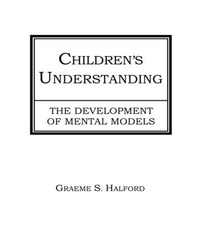
Children's Understanding
The Development of Mental Models
1st Edition
Published on 1. March 1993
Book
Hardback
546 pages
978-0-89859-970-1 (ISBN)
Description
This work argues that cognitive development is experience driven, and processes entailed in acquiring information about the world are analyzed based on recent models of learning and induction. The way information is represented and accessed when performing cognitive tasks is considered paying particular attention to the implications of Parallel Distributed Processing (PDP) models for cognitive development.
The first half of the book contains analyses of human reasoning processes (drawing on PDP models of analogy), development of strategies, and task complexity -- all based on aspects of PDP representations. It is proposed that PDP representations become more differentiated with age, so more vectors can be processed in parallel, with the result that structures of greater complexity can be processed. This model gives an account of previously unexplained difficulties in children's reasoning, including some which were influential in stage theories.
The second half of the book examines processes entailed in some representative cognitive developmental tasks, including transitive inference, deductive inference (categorical syllogisms), hypothesis testing, learning set acquisition, acquisition and transfer of relational structures, humor, hierarchical classification and inclusion, understanding of quantity, arithmetic word problems, algebra, conservation, mechanics, and the concept of mind. Process accounts of tasks are emphasized, based on applications of recent developments in cognitive science.
The first half of the book contains analyses of human reasoning processes (drawing on PDP models of analogy), development of strategies, and task complexity -- all based on aspects of PDP representations. It is proposed that PDP representations become more differentiated with age, so more vectors can be processed in parallel, with the result that structures of greater complexity can be processed. This model gives an account of previously unexplained difficulties in children's reasoning, including some which were influential in stage theories.
The second half of the book examines processes entailed in some representative cognitive developmental tasks, including transitive inference, deductive inference (categorical syllogisms), hypothesis testing, learning set acquisition, acquisition and transfer of relational structures, humor, hierarchical classification and inclusion, understanding of quantity, arithmetic word problems, algebra, conservation, mechanics, and the concept of mind. Process accounts of tasks are emphasized, based on applications of recent developments in cognitive science.
Reviews / Votes
"This is a remarkable book that is comprehensive in scope. It addresses the major issues in the study of cognitive development with particular reference to the development of the understanding process."-Contemporary Psychology
More details
Language
English
Place of publication
Mahwah
United States
Publishing group
Taylor & Francis Inc
Dimensions
Height: 229 mm
Width: 152 mm
Weight
1140 gr
ISBN-13
978-0-89859-970-1 (9780898599701)
Copyright in bibliographic data and cover images is held by Nielsen Book Services Limited or by the publishers or by their respective licensors: all rights reserved.
Schweitzer Classification
Other editions
Additional editions
E-Book
02/2014
1st Edition
Psychology Press Ltd
€73.99
Available for download
E-Book
02/2014
1st Edition
Psychology Press Ltd
€73.99
Available for download
Book
02/1993
Lawrence Erlbaum Associates Inc
€44.72
Article exhausted; check different version
Person
Graeme S. Halford
Content
Contents: Preface. Part I: Introduction. The Nature of Understanding. Part II: General Processes. Mental Models and Representations. Capacity and Complexity. Basic Learning Processes in Cognitive Development. Analogies and Structure-Mapping Processes. Part III: Theory. How Understanding Develops: A Cognitive Developmental Theory. Part IV: Domain-Specific Processes and Concepts. Inferences and Hypothesis Testing. Classification, Quantification, and Conservation. Scientific Concepts. Part V: Conclusions. Concluding Comments.