

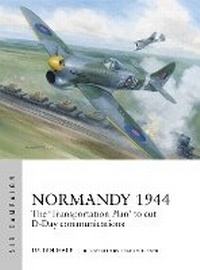
Normandy 1944
The 'Transportation Plan' to cut D-Day communications
Published on 19. June 2025
Book
Paperback/Softback
96 pages
978-1-4728-6580-9 (ISBN)
Description
Packed with illustrations, this is the first book to focus on the 'Transportation Plan', the air campaign to isolate the D-Day beaches from German reinforcements.
As the invasion of Europe grew closer, thought was given to how to use the Allies' substantial forces of heavy bombers in preparation. After much controversy, the plan eventually adopted was the 'Transportation Plan', in which the railway and road networks of France (and hence the German logistical chain) were targeted in order to slow German reinforcements to the Normandy beachhead both before and during the Allied invasion.
In this book, aviation researcher Julian Hale draws on new archive research to explain how this crucial, dangerous and often spectacular campaign was fought. Running from April to July 1944, it would eventually involve heavy and medium bombers of both the RAF and USAAF, with a starring role for the fighter-bombers of the Ninth Air Force. Early attacks by strategic bombers on the French rail nodes were only partially successful at best. In mid-May, the decision was taken to attack bridges and road and rail traffic intensively using fighter-bombers, mainly drawn from the US Ninth.
Illustrated with carefully chosen photos, spectacular battlescene artwork and explanatory maps and 3D diagrams, this is the story of how Allied airpower paved the way for D-Day.
As the invasion of Europe grew closer, thought was given to how to use the Allies' substantial forces of heavy bombers in preparation. After much controversy, the plan eventually adopted was the 'Transportation Plan', in which the railway and road networks of France (and hence the German logistical chain) were targeted in order to slow German reinforcements to the Normandy beachhead both before and during the Allied invasion.
In this book, aviation researcher Julian Hale draws on new archive research to explain how this crucial, dangerous and often spectacular campaign was fought. Running from April to July 1944, it would eventually involve heavy and medium bombers of both the RAF and USAAF, with a starring role for the fighter-bombers of the Ninth Air Force. Early attacks by strategic bombers on the French rail nodes were only partially successful at best. In mid-May, the decision was taken to attack bridges and road and rail traffic intensively using fighter-bombers, mainly drawn from the US Ninth.
Illustrated with carefully chosen photos, spectacular battlescene artwork and explanatory maps and 3D diagrams, this is the story of how Allied airpower paved the way for D-Day.
Reviews / Votes
The work contains interesting information concerning the French railway network, the German network of supply dumps in France and the German rail repair organisation. * Army Rumour Service *More details
Series
Language
English
Place of publication
United Kingdom
Publishing group
Bloomsbury Publishing PLC
Illustrations
Illustrated throughout with 65 photos and 14 pages of colour illustrations
Dimensions
Height: 244 mm
Width: 181 mm
Thickness: 9 mm
Weight
298 gr
ISBN-13
978-1-4728-6580-9 (9781472865809)
Copyright in bibliographic data and cover images is held by Nielsen Book Services Limited or by the publishers or by their respective licensors: all rights reserved.
Schweitzer Classification
Persons
Julian Hale read History at Lancaster University and completed an MA on the RFC and RAF in the Middle East during World War I. In 2012, he joined the RAF Museum and catalogued the Jack Bruce Collection. He was the Assistant Curator for the Museum's Centenary Programme until June 2018, and is the author of The Blitz 1940-41 for Osprey.
Graham Turner is an award-winning historical painter and member of the Guild of Aviation Artists.
Graham Turner is an award-winning historical painter and member of the Guild of Aviation Artists.
Content
INTRODUCTION
CHRONOLOGY
ATTACKER'S CAPABILITIES
Organization
Intelligence
The Allied Expeditionary Air Force
Aircraft
The US Ninth Air Force
RAF Bomber Command
The Pathfinder Force
The United States Strategic Air Forces
Precision Bombing
The Resistance
DEFENDER'S CAPABILITIES
The allied bombing of France to 1944
The target: The French railway network
The Day Fighters
The Night Fighters
Flak
Passive Defence Measures
The German Army in the West
CAMPAIGN OBJECTIVES
Zuckerman's plan
The issue of command
The American counter-proposals
THE CAMPAIGN
Allocation of targets by the AEAF
Bomber Command's operations before the 25 March meeting
Revised Tactics
Bombing accuracy
The Campaign intensifies
The Campaign continues
The Allied Expeditionary Air Force
The tactical campaign
The Resistance contribution
The German reaction
Assessing the course of the campaign
AFTERMATH AND ANALYSIS
The Allied view
The German view
The question of casualties
FURTHER READING
INDEX
CHRONOLOGY
ATTACKER'S CAPABILITIES
Organization
Intelligence
The Allied Expeditionary Air Force
Aircraft
The US Ninth Air Force
RAF Bomber Command
The Pathfinder Force
The United States Strategic Air Forces
Precision Bombing
The Resistance
DEFENDER'S CAPABILITIES
The allied bombing of France to 1944
The target: The French railway network
The Day Fighters
The Night Fighters
Flak
Passive Defence Measures
The German Army in the West
CAMPAIGN OBJECTIVES
Zuckerman's plan
The issue of command
The American counter-proposals
THE CAMPAIGN
Allocation of targets by the AEAF
Bomber Command's operations before the 25 March meeting
Revised Tactics
Bombing accuracy
The Campaign intensifies
The Campaign continues
The Allied Expeditionary Air Force
The tactical campaign
The Resistance contribution
The German reaction
Assessing the course of the campaign
AFTERMATH AND ANALYSIS
The Allied view
The German view
The question of casualties
FURTHER READING
INDEX