


People of the Book
Inviting Communities Into Biblical Interpretation
Published on 3. May 2012
Book
Paperback/Softback
164 pages
978-1-61097-927-6 (ISBN)
Description
We live in an era when the Bible appears to be less and less relevant to mainstream cultures. Those who do care about the Scriptures tend to derive their interpretations secondhand, from the preacher's pulpit or from generalized study guides written by complete strangers. These approaches overlook the communal and conversational nature of the Bible itself. If we hope to recover the transformative power of these ancient texts, and invite our world to reconsider their significance, we will need to engage whole communities together in the bottom-up task of interpretation. People of the Book was written to offer an organic-holistic approach to communal interpretation, an approach that can work for your community and appeal to your wider culture. Halcomb and McNinch envision the Bible as a conversation we are privileged to enter: listening, questioning, wrestling, reasoning, and responding together as authentic people of the Book.
More details
Language
English
Place of publication
Eugene
United States
Product notice
Paperback (trade)
Illustrations
1, black & white illustrations
Dimensions
Height: 203 mm
Width: 127 mm
Thickness: 9 mm
Weight
184 gr
ISBN-13
978-1-61097-927-6 (9781610979276)
Copyright in bibliographic data and cover images is held by Nielsen Book Services Limited or by the publishers or by their respective licensors: all rights reserved.
Schweitzer Classification
Other editions
Additional editions
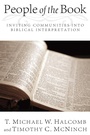
T. Michael W. Halcomb | Timothy C. McNinch
People of the Book
Inviting Communities into Biblical Interpretation
E-Book
05/2012
Wipf and Stock Publishers
€20.49
Available for download
Persons
Michael Halcomb is a PhD Candidate in biblical studies at Asbury Theological Seminary in Wilmore, Kentucky, and teaches at Centenary United Methodist Church in Lexington, Kentucky. He is the author of People of the Book: Inviting Communities into Biblical Interpretation (Wipf and Stock, 2012).