

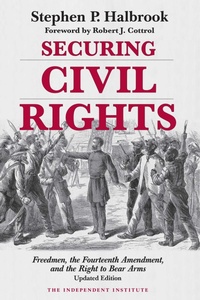
Securing Civil Rights
Freedmen, the Fourteenth Amendment, and the Right to Bear Arms
Published on 19. November 2021
Book
Paperback/Softback
264 pages
978-1-59813-335-6 (ISBN)
Description
Stephen Halbrook's groundbreaking study of freed slaves and the right to bear arms in the aftermath of the Civil War, cited in Supreme Court cases, now with a new foreword by Robert J. Cottrol.
What did it mean to take civil rights seriously—especially the “right to bear arms”—in the years following the abolition of slavery? By quoting legislative debates, Congressional hearings on Ku Klux Klan violence, and newspapers and law books of the time, constitutional scholar Stephen Halbrook shows that both supporters and opponents of the Fourteenth Amendment (1868) believed that it protected all Bill of Rights guarantees—especially the Second Amendment—from infringement by the states.
From the Freedmen’s Bureau Act of 1866 to the Supreme Court’s decision in United States v. Cruikshank (1876), Halbrook paints a vivid portrait of a political and legal system grappling with the true meaning of civil rights.
“Trusting ex-slaves to own firearms was, by any definition, the cutting edge in true belief in civil rights,” Halbrook writes. “It remains to be seen whether contemporary society will accommodate the same rights of the freedmen that the Framers of the Fourteenth Amendment sought to guarantee.”
Although Halbrook concentrates on the right to keep and bear arms, he also includes a comprehensive analysis of the general topic of the relationship between the Bill of Rights and the state governments after the ratification of the Fourteenth Amendment.
Cited by both the U.S. Supreme Court in its historic landmark decision in the McDonald case (2010) and the Washington Supreme Court in State of Washington v. Christopher William Sieyes case (2010) as the leading account of the relationship between the Second Amendment and the states during Reconstruction, Halbrook’s insightful narrative will help a larger audience better understand why earlier generations of Americans viewed the right to bear arms as essential for securing civil rights.
What did it mean to take civil rights seriously—especially the “right to bear arms”—in the years following the abolition of slavery? By quoting legislative debates, Congressional hearings on Ku Klux Klan violence, and newspapers and law books of the time, constitutional scholar Stephen Halbrook shows that both supporters and opponents of the Fourteenth Amendment (1868) believed that it protected all Bill of Rights guarantees—especially the Second Amendment—from infringement by the states.
From the Freedmen’s Bureau Act of 1866 to the Supreme Court’s decision in United States v. Cruikshank (1876), Halbrook paints a vivid portrait of a political and legal system grappling with the true meaning of civil rights.
“Trusting ex-slaves to own firearms was, by any definition, the cutting edge in true belief in civil rights,” Halbrook writes. “It remains to be seen whether contemporary society will accommodate the same rights of the freedmen that the Framers of the Fourteenth Amendment sought to guarantee.”
Although Halbrook concentrates on the right to keep and bear arms, he also includes a comprehensive analysis of the general topic of the relationship between the Bill of Rights and the state governments after the ratification of the Fourteenth Amendment.
Cited by both the U.S. Supreme Court in its historic landmark decision in the McDonald case (2010) and the Washington Supreme Court in State of Washington v. Christopher William Sieyes case (2010) as the leading account of the relationship between the Second Amendment and the states during Reconstruction, Halbrook’s insightful narrative will help a larger audience better understand why earlier generations of Americans viewed the right to bear arms as essential for securing civil rights.
More details
Edition
Updated Edition
Language
English
Place of publication
Oakland
United States
Target group
Professional and scholarly
Product notice
Paperback (trade)
Unsewn / adhesive bound
Dimensions
Height: 226 mm
Width: 150 mm
Thickness: 14 mm
Weight
277 gr
ISBN-13
978-1-59813-335-6 (9781598133356)
Copyright in bibliographic data and cover images is held by Nielsen Book Services Limited or by the publishers or by their respective licensors: all rights reserved.
Schweitzer Classification
Other editions
Additional editions
Stephen P. Halbrook
Securing Civil Rights
Freedmen, the Fourteenth Amendment, and the Right to Bear Arms
E-Book
03/2022
Simon + Schuster LLC
€9.88
Available for download
Persons
Stephen P. Halbrook is a Research Fellow with the Independent Institute who has argued and won three constitutional law cases before the U.S. Supreme Court. Dr. Halbrook is the author of eight books including The Founders’ Second Amendment: Origins of the Right to Bear Arms; Securing Civil Rights: Freedmen, the Fourteenth Amendment, and the Right To Bear Arms; That Every Man Be Armed: The Evolution of a Constitutional Right; A Right to Bear Arms: State and Federal Bills of Rights and Constitutional Guarantees; Target Switzerland (also in German, French, Italian, and Polish editions); and The Swiss and the Nazis: How the Alpine Republic Survived in the Shadow of the Third Reich. He holds a Ph.D. in philosophy from Florida State University and J.D. from Georgetown University Law Center. His popular articles have appeared in the Wall Street Journal, San Antonio Express-News, Environmental Forum, USA Today, and Washington Times, and he has appeared on numerous national TV/radio programs such as "The Phil Donahue Show" and programs on Fox Business Network, Court TV, Voice of America, CNN, and C-SPAN.