

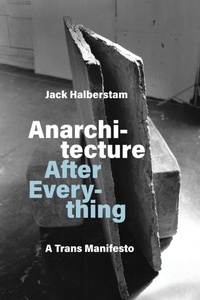
Anarchitecture After Everything
A Trans Manifesto
Will be published approx. on 18. August 2026
Book
Paperback/Softback
296 pages
978-0-262-05242-9 (ISBN)
Description
A revolutionary way of seeing bodies and built environment that unites radical politics and trans aesthetics. From a leading author and queer theorist known for reframing many of the most pressing questions about counter-intuitive ways of being. Anarchitecture, a radical aesthetic practice of unbuilding and unmaking the built environment in the 1970s, staged a vigorous confrontation with urban renewal and gentrification projects. In Anarchitecture After Everything, Jack Halberstam identifies a powerful lexicon of transformation within Anarchitecture and joins the art movement s practices of cutting and splitting with the destabilizing power of transness to detonate acts of formal violence in our time. Anarchitecture describes the aesthetic practice of splitting and cutting, dismantling and undoing, unmaking and unbuilding, and, ultimately unworlding. The trans body splits bodily coherence, dismantles the gender binary, and unbuilds bodily meaning. In these chapters, Gordon Matta-Clark s cuts, along with Alvin Baltrop s images of collapsing warehouses and Beverly Buchanan s post-demolition fragmentary sculptures, return with a vengeance through the contemporary aesthetic gestures of Yve Laris Cohen, Jesse Darling, Nicole Eisenman, Kiyan Williams, Cassils, boychild and Every Ocean Hughes. Anarchitecture unmakes space and offers a new rhetoric for emptiness. In its conclusion, the book explores this rhetoric through Renee Gladman s anarchitectural experiments with language. By reading anarchitecture through transness and transness through anarchitecture, Halberstam helps us see the trans body as a space of radical unmaking and as a portal to new lexicons for transformation.
Reviews / Votes
ENDORSEMENTS"A dazzling, groundbreaking series of meditations on the relationality of trans bodies and buildings. Halberstam's deft analyses of the places, artworks, narratives, and histories produced by artists deeply committed to dismantling modernity's oppressive enclosures could not be more timely than in this moment of fascism's violent retrenchment."
-Mabel O. Wilson, author of Begin with the Past: Building the National Museum of African American History and Culture
"A must read. Understanding trans bodies as 'unarchitectural' projects and architecture as a task for building social and political norms, Halberstam has written a new theory of the body as much as a manifesto for unbuilding architecture."
-Paul B. Preciado, author of Dysphoria Mundi: A Diary of Planetary Transition
"Finally, the trans aesthetics we've been waiting for. Halberstam's blazing manifesto argues for the reshaping of bodies and worlds through anarchitecture. For those seeking an antiformal aesthetics connected to an insurrectionary politics of dismantling an already-broken world, this book is your weapon."
-Claire Bishop, author of Artificial Hells and Disordered Attention
"Halberstam's timely reading of anarchitecture emphatically unsettles the concept in the most generative ways imaginable, treating the fugitive interests of the trans and racialized body as not only formative, but more relevant than ever."
-Pamela M. Lee, author of Think Tank Aesthetics: Midcentury Modernism, the Cold War, and the Neoliberal Present
More details
Language
English
Place of publication
Cambridge (Massachusetts)
United States
Publishing group
MIT Press Ltd
Illustrations
28 COLOR ILLS., 21 BLACK AND WHITE ILLS.
Dimensions
Height: 241 mm
Width: 159 mm
Weight
369 gr
ISBN-13
978-0-262-05242-9 (9780262052429)
Copyright in bibliographic data and cover images is held by Nielsen Book Services Limited or by the publishers or by their respective licensors: all rights reserved.
Schweitzer Classification
Person
Jack Halberstam is David Feinson Professor of the Humanities at Columbia University and the author of seven books, including Trans*: A Quick and Quirky Account of Gender Variance, The Queer Art of Failure, and Female Masculinity. A 2024 Guggenheim fellow, he is the winner of the Arcus/Places Prize in 2018 for innovative public scholarship and was recently the subject of the film So We Moved by Adam Pendleton in 2022.