

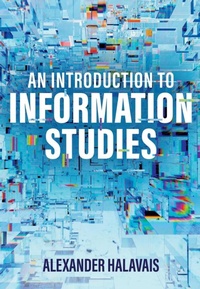
An Introduction to Information Studies
Datafying People, Places, and Things
1st Edition
Will be published approx. on 12. December 2025
Book
Hardback
272 pages
978-1-5095-6384-5 (ISBN)
Description
We live our entire lives in an information society, but too frequently feel like we are rushing to catch up with the latest technological changes. Despite the overwhelming influence of information networks and their potential as tools for social change, many find it difficult to put these changes into a broader sociotechnical context.
An Introduction to Information Studies is a cutting-edge introductory textbook which provides a broad survey of the field. Weaving together important insights from information science, history, regulation and culture, the text frames the social changes that have marked the first decades of the twenty-first century, and highlights some of the most significant issues we face today. Topics covered include organization, search, metadata, knowledge, open standards, and AI. The text provides a starting point for understanding the connective threads that guide technologies, and the relationships between social power and technological change that remain constant in relation to information. Understanding these relationships is essential to engaging ethically with large-scale social data systems, and to shaping our collective futures.
Full of accessible examples and pedagogical features, An Introduction to Information Studies is a field-defining textbook for undergraduates in information studies, social data science, and information and communication fields more generally. It is also an important resource for scholars, policymakers, artists and engineers.
An Introduction to Information Studies is a cutting-edge introductory textbook which provides a broad survey of the field. Weaving together important insights from information science, history, regulation and culture, the text frames the social changes that have marked the first decades of the twenty-first century, and highlights some of the most significant issues we face today. Topics covered include organization, search, metadata, knowledge, open standards, and AI. The text provides a starting point for understanding the connective threads that guide technologies, and the relationships between social power and technological change that remain constant in relation to information. Understanding these relationships is essential to engaging ethically with large-scale social data systems, and to shaping our collective futures.
Full of accessible examples and pedagogical features, An Introduction to Information Studies is a field-defining textbook for undergraduates in information studies, social data science, and information and communication fields more generally. It is also an important resource for scholars, policymakers, artists and engineers.
More details
Language
English
Place of publication
Oxford
United Kingdom
Publishing group
John Wiley and Sons Ltd
Target group
College/higher education
Product notice
sewn/stitched
Cloth over boards
Dimensions
Height: 246 mm
Width: 175 mm
Thickness: 25 mm
Weight
635 gr
ISBN-13
978-1-5095-6384-5 (9781509563845)
Copyright in bibliographic data and cover images is held by Nielsen Book Services Limited or by the publishers or by their respective licensors: all rights reserved.
Schweitzer Classification
Other editions
Additional editions
E-Book
02/2026
1st Edition
Wiley-Scrivener
€18.99
Available for download
Book
approx. 12/2025
1st Edition
Polity Press
€28.50
Not yet published
Person
Alexander Halavais is Associate Professor of Social Data Science at Arizona State University.
Content
Preface
Chapter 1: Information and communication technologies
Chapter 2: Data in Motion
Chapter 3: Encoding/decoding
Chapter 4: Metadata
Chapter 5: Finding
Chapter 6: Locative
Chapter 7: Intimate technologies
Chapter 8: Decision support
Chapter 9: Informed organizations
Chapter 10: Networks, publics, platforms
Chapter 11: Information literacy
Chapter 12: Open and shut
Chapter 13: Mechanical knowledge
Chapter 14: Governing information
Chapter 15: Ethical data
Acknowledgements
Endnotes
Chapter 1: Information and communication technologies
Chapter 2: Data in Motion
Chapter 3: Encoding/decoding
Chapter 4: Metadata
Chapter 5: Finding
Chapter 6: Locative
Chapter 7: Intimate technologies
Chapter 8: Decision support
Chapter 9: Informed organizations
Chapter 10: Networks, publics, platforms
Chapter 11: Information literacy
Chapter 12: Open and shut
Chapter 13: Mechanical knowledge
Chapter 14: Governing information
Chapter 15: Ethical data
Acknowledgements
Endnotes