

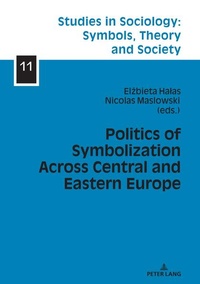
Politics of Symbolization Across Central and Eastern Europe
Published on 26. February 2021
Book
Hardback
304 pages
978-3-631-84285-0 (ISBN)
Description
Politics of symbolization affects the semantics of identities and power relations between various subjects, and encompasses the changing meanings of social spaces, times, historical narratives, as well as modalities of collective memory. The volume focuses on politics of symbolization across Central and Eastern Europe understood as complex spaces of semiosis that are rife with similarities and differences. Politics of symbolization consists of various strategies of referring to past collective experiences from the perspective of projected visions and representations of the future. The European Union and its politics of symbolization is relevant in this respect. The volume facilitates understanding of the problems associated with politics of symbolization in Central and Eastern Europe.
More details
Persons
Elzbieta Halas is Full Professor of Sociology at the University of Warsaw. Her research interests are interpretative social theory, and cultural and relational sociology.
Nicolas Maslowski, Ph.D., is director of the CCFEF at the University of Warsaw, specializing in collective memory and historical sociology.
Content
European Space, Semiosis and Politics of Symbolization Across Central and Eastern Europe
Time and Semiosis of History: Symbolic Conflicts over Remembering and Forgetting
Symbolic Construction of Communities: New Beginnings and New Divides
Symbolic Politics of European (Dis)Unification
Time and Semiosis of History: Symbolic Conflicts over Remembering and Forgetting
Symbolic Construction of Communities: New Beginnings and New Divides
Symbolic Politics of European (Dis)Unification