

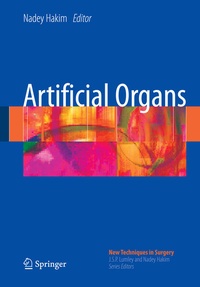
Artificial Organs
Published on 28. October 2010
Book
Paperback/Softback
X, 190 pages
978-1-84996-833-1 (ISBN)
Description
Artificial organs have come a long way since the first dialysis machine, the rotating artificial kidney, was invented in 1944 by Willem Johan Kolff, who is known as the ''father of artificial organs''. At that time he met stiff resistance from his hospital superiors but his persistence paid off and a million saved lives have been attributed to his first invention. He was indeed the first to mix medicine and engineering. An artificial organ is any machine, device, or other material that is used to replace the functions of a faulty or missing organ or other parts of the human body. Some body parts are more of a challenge than others. The heart has one purpose and it is to pump blood; however, the liver has biochemical and physiological functions which are difficult to simulate. The implantation of an artificial organ is critical because of the patient life dependency on the artificial organ itself. The treatment of choice is organ transplantation, however, transplant candidates face a long waiting time and many die while on the waiting list. In addition there are patients who are excluded from transplantation because of age or presence of other diseases. This book p- sents an overview of the current state of knowledge of artificial organs including the liver, pancreas, kidney, heart, cochlea, skin, stem cells, composite tissue allograft, and sphincters.
More details
Series
Edition
Softcover reprint of hardcover 1st ed. 2009
Language
English
Place of publication
London
United Kingdom
Target group
Professional and scholarly
Professional/practitioner
Illustrations
11 s/w Abbildungen, 53 farbige Abbildungen
X, 190 p. 64 illus., 53 illus. in color.
Dimensions
Height: 254 mm
Width: 178 mm
Thickness: 11 mm
Weight
380 gr
ISBN-13
978-1-84996-833-1 (9781849968331)
DOI
10.1007/978-1-84882-283-2
Schweitzer Classification
Other editions
Additional editions
Content
Management of Multiorgan Failure After Artificial Organ Implantation.- Artificial Circulatory Support.- The Artificial Kidney.- Liver Substitution.- Glucose Sensors and Insulin Pumps: Prospects for an Artificial Pancreas.- From Basic Wound Healing to Modern Skin Engineering.- Artificial Sphincters.- Cochlear Implant.- Stem Cells and Organ Replacement.- Composite Tissue Transplantation: A Stage Between Surgical Reconstruction and Cloning.