

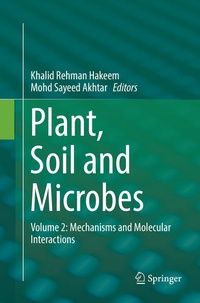
Plant, Soil and Microbes
Description
The interactions between the plant, soil, and microbes are very complex in nature and may be antagonistic, mutualistic, or synergistic, depending upon the types of microorganisms and their association with the plant and soil. The multi-trophictactics are involved in these types of interactions to nourish the plants in various habitats and conditions. Understanding the mechanisms of these interactions is highly desired to utilize the knowledge in such an eco-friendly and sustainable way, which may not only resolve the upcoming food security issues but also make the environment green by reducing the chemical inputs. Plant, Soil and Microbes: Mechanisms and Molecular Interactions, along with the recently published Plant, Soil and Microbes: Implications in Crop Science, provide detailed accounts of the exquisite and delicate balance between the three critical components of agronomy. Specifically, these two titles focus on the basis of nutrient exchange between the microorganisms and thehost plants, the mechanism of disease protection and the recent molecular details emerged from studying this multitropic interaction. Together they provide a solid foundation for the students, teachers, and researchers interested in soil microbiology, plant pathology, ecology and agronomy.
More details
Other editions
Additional editions
Persons
Dr. Mohd. Sayeed Akhtar (PhD) is working as a Assistant Professor in Gandhi Faiz-E-Aam College, Shahjahanpur, affiliated to M.J.P. Rohailkhand University, Braeilly, U.P., India. He has received his PhD degree from Aligarh Muslim University (AMU), India in 2008. He has conducted his postdoctoral research at the Botanical Institute, University of Basel (BIB), Switzerland (2008-2010) and Chonbuk National University (CBNU), Republic of Korea in 2011, respectively, and also works Assistant Professor, Department of Biology, College of Natural Sciences, Jimma university, Jimma, Ethiopia (form 2011-2014), and Fellow Researcher UDQ9 at the Institute of Tropical Agriculture, Universiti Putra Malaysia (UPM), Serdang, Selangor, Malaysia (from 2014-2015). Dr. Akhtar has more than twelve years of research and teaching experience in Soil Microbiology, Applied Microbiology, Environmental Microbiology, Molecular Biology, Plant Pathology and Plant Nano-biotechnology. Dr. Akhtar has received several prestigious fellowships at national and international levels. His promising approach and dedication stands him in the row of foremost scientist in the field of Plant-Microbe Interaction and Plant Nano-biotechnology. He is author and coauthor of about 45 research articles in peer reviewed journals, contributed 12 book chapters in the books published by Springer-Verlag and also edited 3 books with international publishers. He is serving the scientific community as editorial board member and reviewer of several high impact international Journals. His current research is focused on the rhizospheric plant-microbe interactions and their molecular biotechnology, bioremediation, biomineralization, nano-fertilizers and Nanobiotechnology.
Content
Plant Microbe Interactions- A molecular approach.- Interaction between pesticide and soil microorganisms and their degradation: A molecular approach.- In silico Functional Analyses of SWEETs Reveal Cues for Their Role in AMF Symbiosis.- Root exudates and their molecular interactions with rhizospheric microbes.- A Proteomic Approach to Understand the Tripartite Interactions between Plant-Trichoderma-Pathogen: Investigating the Potential for Efficient Biological Control.- Mycorrhizal Association and Their Role in Plant Disease Protection.- Response of PGPR and AM fungi towards growth and secondary metabolite production in medicinal and aromatic plants.- Rhizospheric microbes-soil-plant root interaction: Influence on micronutrients uptake and bioavailability.- Soil bacteria for polycyclic aromatic hydrocarbons (PAHs) remediation: application potentialities and limitations.- Bacterial determinants and plant defense induction-their role as biocontrol agent in sustainable agriculture.- Occurrence, distribution and molecular identification of phytoplasma diseases in ornamental plants.- Isolation and identification of allelochemicals from ascocarp of Tuber species.- Mycorrhizal association: A safeguard for plant pathogen.- Potential of Bacillus thuringiensis in the management of pernicious lepidopteran pests.- Genomics of Plant, Soil and Microbe Interaction.- Soil Microbe Diversity and Root Exudates as Important Aspects of Rhizosphere Ecosystem.- An Insight into the Legume-Rhizobium Interaction.- Role of phytohormones in stress tolerance of plants.- Soil Pollution and Remediation.