

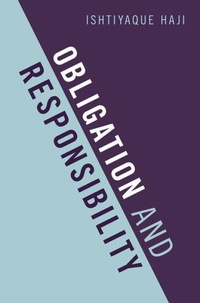
Obligation and Responsibility
Published on 4. April 2023
Book
Hardback
280 pages
978-0-19-765782-9 (ISBN)
Description
Many philosophers have sought to distinguish moral obligation from moral responsibility. In this book, author Ishtiyaque Haji argues that these concepts, though still distinct, are more similar than many think.
First, conceptual ties between obligation and responsibility speak largely in favor of responsibility's requiring alternatives, challenging the view that responsibility does not require freedom to do otherwise. Second, many philosophers champion responsibility semicompatibilism, which mean that even if determinism is incompatible with the freedom to do otherwise, it is compatible with responsibility. Essential relations between obligation and responsibility are deployed against this thesis, and the parallel thesis of obligation semicompatibilism is also rejected. An upshot of forsaking these two species of semicompatibilism is that determinism threatens both obligation and responsibility by eliminating alternate possibilities. Third, many concur that whereas you may now no longer have an obligation that you previously had, you cannot now fail to be blameworthy for something for which you were formerly to blame. Haji rejects this immutability thesis about blameworthiness.
Haji does find one legitimate difference between obligation and responsibility: while how one acquires one's values may significantly influence whether one is responsible for much of their conduct, obligation is not "historical" in this way.
First, conceptual ties between obligation and responsibility speak largely in favor of responsibility's requiring alternatives, challenging the view that responsibility does not require freedom to do otherwise. Second, many philosophers champion responsibility semicompatibilism, which mean that even if determinism is incompatible with the freedom to do otherwise, it is compatible with responsibility. Essential relations between obligation and responsibility are deployed against this thesis, and the parallel thesis of obligation semicompatibilism is also rejected. An upshot of forsaking these two species of semicompatibilism is that determinism threatens both obligation and responsibility by eliminating alternate possibilities. Third, many concur that whereas you may now no longer have an obligation that you previously had, you cannot now fail to be blameworthy for something for which you were formerly to blame. Haji rejects this immutability thesis about blameworthiness.
Haji does find one legitimate difference between obligation and responsibility: while how one acquires one's values may significantly influence whether one is responsible for much of their conduct, obligation is not "historical" in this way.
More details
Language
English
Place of publication
New York
United States
Target group
Professional and scholarly
Product notice
sewn/stitched
Cloth over boards
Dimensions
Height: 211 mm
Width: 147 mm
Thickness: 23 mm
Weight
440 gr
ISBN-13
978-0-19-765782-9 (9780197657829)
Copyright in bibliographic data and cover images is held by Nielsen Book Services Limited or by the publishers or by their respective licensors: all rights reserved.
Schweitzer Classification
Other editions
Additional editions


Person
Ishtiyaque Haji is Professor of Philosophy at the University of Calgary. His research interests include ethical theory, philosophy of action, metaphysics, and philosophical psychology.
Content
1. Obligation and Responsibility: Four Alleged Differences
2. Alternate Possibility (AP) Arguments for Varieties of Incompatibilism
3. Obligation Semicompatibilism
4. Responsibility Semicompatibilism
5. The Free Will Premise
6. Internalism and Externalism
7. More Radical Reversal Stories and Appraisals
8. Obligation, Blameworthiness, and Time
9. Obligation, Overridingness, and Punishment
10. Concluding Reflections
2. Alternate Possibility (AP) Arguments for Varieties of Incompatibilism
3. Obligation Semicompatibilism
4. Responsibility Semicompatibilism
5. The Free Will Premise
6. Internalism and Externalism
7. More Radical Reversal Stories and Appraisals
8. Obligation, Blameworthiness, and Time
9. Obligation, Overridingness, and Punishment
10. Concluding Reflections