

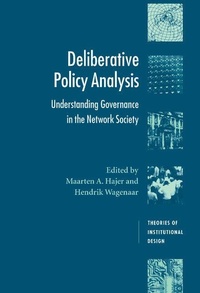
Deliberative Policy Analysis
Understanding Governance in the Network Society
Published on 15. May 2003
Book
Hardback
324 pages
978-0-521-82366-1 (ISBN)
Description
What kind of policy analysis is required now that governments increasingly encounter the limits of governing? Exploring the contexts of politics and policy making, this 2003 book presents an original analysis of the relationship between state and society, and new possibilities for collective learning and conflict resolution. The key insight of the book is that democratic governance calls for a new deliberatively-oriented policy analysis. Traditionally policy analysis has been state-centered, based on the assumption that central government is self-evidently the locus of governing. Drawing on detailed empirical examples, the book examines the influence of developments such as increasing ethnic and cultural diversity, the complexity of socio-technical systems, and the impact of transnational arrangements on national policy making. This contextual approach indicates the need to rethink the relationship between social theory, policy analysis, and politics. The book is essential reading for all those involved in the study of public policy.
Reviews / Votes
'This collection is a landmark in post-positivist policy studies that will help set the field's agenda for years to come. Pioneering linkages between deliberative democracy, critical policy analysis, and governance in the network society, Deliberative Policy Analysis is a key text for the interdisciplinary policy studies field.' John S. Dryzek, Australian National University 'These striking essays rethink both the practice and the foundations of policy analysis in the face of conflict and complex networks, risk and uncertainty. For all those concerned with making governance work in the coming years, this collection makes a provocative and practical contribution. Policy analysts at last will say, 'Yes, that's what I have to do'!' John Forester, Cornell UniversityMore details
Series
Language
English
Place of publication
Cambridge
United Kingdom
Target group
Professional and scholarly
Illustrations
1 Maps; 12 Line drawings, unspecified
Dimensions
Height: 235 mm
Width: 157 mm
Thickness: 22 mm
Weight
622 gr
ISBN-13
978-0-521-82366-1 (9780521823661)
Copyright in bibliographic data and cover images is held by Nielsen Book Services Limited or by the publishers or by their respective licensors: all rights reserved.
Schweitzer Classification
Other editions
Additional editions
Maarten A. Hajer | Hendrik Wagenaar
Deliberative Policy Analysis
Understanding Governance in the Network Society
E-Book
05/2006
1st Edition
Cambridge University Press
€32.49
Available for download
Maarten A. Hajer | Hendrik Wagenaar
Deliberative Policy Analysis
Understanding Governance in the Network Society
Book
05/2003
Cambridge University Press
€49.40
Shipment within 15-20 days
Persons
Maarten A. Hajer is Professor of Public Policy and Political Science, Department of Political Science, University of Amsterdam. Hendrik Wagenaar is Associate Professor of Public Policy, Leiden University and Senior Researcher, Netherlands Institute for the Study of Crime and Law Enforcement.
Content
Editors' introduction Maarten A. Hajer and Hendrik Wagenaar; Part I. Policy Conflict and Deliberation in the Network Society: 1. Collaborative policy making: governance through dialogue Judith Innes and David Booher; 2. Place, identity and local politics: analysing initiatives in deliberative governance Patsy Healey, Claudio de Magelhaes, Ali Madanipour and John Pendlebury; 3. A frame in the fields. Policy making and the reinvention of politics Maarten Hajer; Part II. Rethinking Policy Practice: 4. Democracy through policy discourse Douglas Torgerson; 5. Understanding policy practices: action, dialectic and deliberation in policy analysis Hendrik Wagenaar and Scott Noam Cook; 6. Reframing practice David Laws and Martin Rein; Part III. Foundations of a Deliberative Policy Analysis: 7. Beyond empiricism: policy analysis as deliberative practice Frank Fischer; 8. Accessing local knowledge: policy analysis and communities of meaning Dvora Yanow; 9. Theoretical strategies of post-structuralist policy analysis: towards an analytics of government Herbert Gottweiss.