

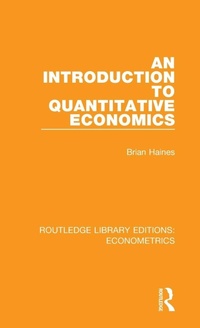
An Introduction to Quantitative Economics
Economics and Society Series
1st Edition
Published on 6. March 2018
Book
Hardback
166 pages
978-0-8153-5022-4 (ISBN)
Description
Originally published in 1978. This book is designed to enable students on main courses in economics to comprehend literature which employs econometric techniques as a method of analysis, to use econometric techniques themselves to test hypotheses about economic relationships and to understand some of the difficulties involved in interpreting results. While the book is mainly aimed at second-year undergraduates undertaking courses in applied economics, its scope is sufficiently wide to take in students at postgraduate level who have no background in econometrics - it integrates fully the mathematical and statistical techniques used in econometrics with micro- and macroeconomic case studies.
More details
Series
Language
English
Place of publication
New York
United States
Publishing group
Taylor & Francis Inc
Target group
College/higher education
Dimensions
Height: 222 mm
Width: 145 mm
Thickness: 13 mm
Weight
351 gr
ISBN-13
978-0-8153-5022-4 (9780815350224)
Copyright in bibliographic data and cover images is held by Nielsen Book Services Limited or by the publishers or by their respective licensors: all rights reserved.
Schweitzer Classification
Other editions
Additional editions
Book
06/2019
1st Edition
Routledge
€54.30
Shipment within 15-20 days
Brian Haines
An Introduction to Quantitative Economics
E-Book
04/2018
1st Edition
Routledge
€48.49
Available for download
Person
Content
Preface Part 1 1. Introduction to the Relationship between Variables 2. A Basic Revision of Statistical Concepts 3. The Principle of Ordinary Least Squares and Simple Regression Formulae 4. Nonlinear Relationships and Multiple Regression Part 2 5. A Breakdown of the Standard Assumptions made about the Error Term 6. Statistical Data, Distributed Lag Models and Dummy Variables 7. Empirical Studies in Macroeconomics 8. Structural Equations and the Identification Problem. Numerical Answers