

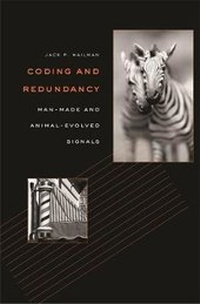
Coding and Redundancy
Man-Made and Animal-Evolved Signals
Published on 1. June 2008
Book
Hardback
272 pages
978-0-674-02795-4 (ISBN)
Description
This book explores the strikingly similar ways in which information is encoded in nonverbal man-made signals (e.g., traffic lights and tornado sirens) and animal-evolved signals (e.g., color patterns and vocalizations). The book also considers some coding principles for reducing certain unwanted redundancies and explains how desirable redundancies enhance communication reliability.
Jack Hailman believes this work pioneers several aspects of analyzing human and animal communication. The book is the first to survey man-made signals as a class. It is also the first to compare such human-devised systems with signaling in animals by showing the highly similar ways in which the two encode information. A third innovation is generalizing principles of quantitative information theory to apply to a broad range of signaling systems. Finally, another first is distinguishing among types of redundancy and their separation into unwanted and desirable categories.
This remarkably novel book will be of interest to a wide readership. Appealing not only to specialists in semiotics, animal behavior, psychology, and allied fields but also to general readers, it serves as an introduction to animal signaling and to an important class of human communication.
Jack Hailman believes this work pioneers several aspects of analyzing human and animal communication. The book is the first to survey man-made signals as a class. It is also the first to compare such human-devised systems with signaling in animals by showing the highly similar ways in which the two encode information. A third innovation is generalizing principles of quantitative information theory to apply to a broad range of signaling systems. Finally, another first is distinguishing among types of redundancy and their separation into unwanted and desirable categories.
This remarkably novel book will be of interest to a wide readership. Appealing not only to specialists in semiotics, animal behavior, psychology, and allied fields but also to general readers, it serves as an introduction to animal signaling and to an important class of human communication.
Reviews / Votes
[Coding and Redundancy] will provide behavioral ecologists with new ideas about the mechanisms underlying communication, which may give fresh insights into signal evolution. -- Redouan Bshary * Nature * Hailman employs numerous examples to make the case that coding patterns and redundancy in both animals and human signaling have much in common. The strength of this book lies in Hailman's ability to support mathematical theory with specific examples based on his vast knowledge of animal behavior. -- F. T. Kuserk * Choice * Eminently entertaining, this book blazes the trail for thinking about animal communication in a manner that will interest ordinary readers as well as specialists. Hailman classifies animal signals and compares them to an interesting diversity of human signals. The passages on human signals, like Morse code, and animal signals, like the wings of ducks, make for fascinating reading. -- R. Haven Wiley, Professor of Biology and Ecology, University of North Carolina at Chapel HillMore details
Language
English
Place of publication
Cambridge, Mass
United States
Target group
College/higher education
Illustrations
25 line illustrations, 14 tables
Dimensions
Height: 235 mm
Width: 156 mm
ISBN-13
978-0-674-02795-4 (9780674027954)
Copyright in bibliographic data and cover images is held by Nielsen Book Services Limited or by the publishers or by their respective licensors: all rights reserved.
Schweitzer Classification
Other editions
Additional editions
E-Book
05/2008
Harvard University Press
€133.99
Available for download
Person
Jack P. Hailman was Professor of Zoology, Emeritus, at the University of Wisconsin and Research Associate at Archbold Biological Station.
Content
* List of Tables and Figures * Foreword * Preface * *1. Introduction * Part I. Coding *2. Binary Coding *3. Multi-valued Coding *4. Multivariate Coding * Part II. Redundancy *5. Intrinsic Redundancy *6. Redundancy Reduction *7. Designed Redundancy * Appendix A: List of Equations * Appendix B: How to Find Base-2 Logarithms on a Pocket Calculator * Appendix C: Binary Pervasiveness * Notes * References * Index