

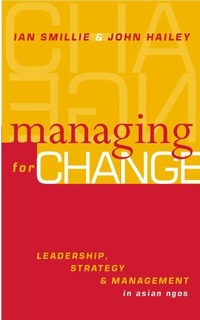
Managing for Change
Leadership, Strategy and Management in Asian NGOs
Will be published approx. on 1. October 2000
Book
Paperback/Softback
240 pages
978-1-85383-722-7 (ISBN)
Description
An increasing proportion of the world's poor is dependent on NGOs for the support the state cannot or will not provide, but little has been written to analyze or guide best management practice, which is so critical to their success. Managing for Change addresses the key operational issues facing NGO managers, drawing lessons from the reality of southern NGOs. It explores areas such as the formation of strategy, effective NGO leadership, the handling of donor relations, staff motivation and development, and the management styles most appropriate to crises and change.
More details
Language
English
Place of publication
London
United Kingdom
Publishing group
Taylor & Francis Ltd
Target group
College/higher education
Professional Practice & Development
Dimensions
Height: 216 mm
Width: 138 mm
Weight
340 gr
ISBN-13
978-1-85383-722-7 (9781853837227)
Copyright in bibliographic data and cover images is held by Nielsen Book Services Limited or by the publishers or by their respective licensors: all rights reserved.
Schweitzer Classification
Other editions
Additional editions
E-Book
09/2013
1st Edition
Routledge
€59.49
Available for download
E-Book
09/2013
1st Edition
Routledge
€59.49
Available for download

Book
10/2000
Earthscan Ltd
€126.28
Withdrawn from sale
Persons
Ian Smillie is a development consultant and co-author of Stakeholders: Government-NGO Partnerships for International Development. John Hailey is deputy Director of Oxford Brookes University Business School and a co-founder of the International Training and Research Centre (INTRAC).
Content
Chapter 1 Introduction; Chapter 2 A Dangerous Sea; Chapter 3 Symbols and Systems; Chapter 4 Learning for Change; Chapter 5 Strategy; Chapter 6 The Accidental NGO; Chapter 7 Leadership and the Thoroughly Modern Manager; Chapter 8 Conclusions;