

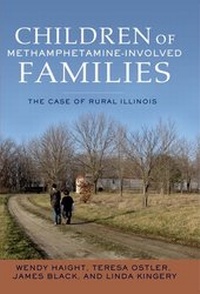
Children of Methamphetamine-Involved Families
Published on 27. November 2008
Book
Hardback
264 pages
978-0-19-532605-5 (ISBN)
Description
Methamphetamine destroys not only the lives of those who become addicted to it, but affects all corners of society, including the most innocent: children. This important book follows the case of rural Illinois, where in the mid-1990s methamphetamine production and misuse became a significant problem and, as a result, child welfare professionals saw an influx onto their caseloads of children whose parents were involved with the drug. The authors' account of the problems the children face, and of the efforts to help them, sheds useful light on possibilities for many other situations.
Using a case-based, mixed-methods approach that capitalizes on rich qualitative data, the book examines parental methamphetamine misuse from a sociocultural perspective. Using extensive child welfare investigation data, participant observation, and in-depth interviews, the authors describe the perilous home lives of rural children whose parents misuse methamphetamine, where they are exposed to maltreatment, criminal behavior, and environmental danger. Many children end up with significant emotional and behavioral problems, especially posttraumatic symptoms, that will stay with them for years. Based on this descriptive information and the existing clinical literature, the authors designed a relationship- and narrative-based mental health program, "Life Story Intervention," that draws on the strengths of many rural communities including storytelling traditions. Pilot data from the program, shared here, suggests some positive results of the intervention on children's psychological functioning.
To eradicate the problems caused by methamphetamine abuse will require years more of concerted effort and collaboration such as that described in this book. Social work and child welfare professors and students, researchers, practitioners, and policy-makers will find inspiration in this account of the success that can result, with this issue and others, when practitioners and researchers join forces to understand complex social phenomena and design, implement, and assess effective interventions.
Using a case-based, mixed-methods approach that capitalizes on rich qualitative data, the book examines parental methamphetamine misuse from a sociocultural perspective. Using extensive child welfare investigation data, participant observation, and in-depth interviews, the authors describe the perilous home lives of rural children whose parents misuse methamphetamine, where they are exposed to maltreatment, criminal behavior, and environmental danger. Many children end up with significant emotional and behavioral problems, especially posttraumatic symptoms, that will stay with them for years. Based on this descriptive information and the existing clinical literature, the authors designed a relationship- and narrative-based mental health program, "Life Story Intervention," that draws on the strengths of many rural communities including storytelling traditions. Pilot data from the program, shared here, suggests some positive results of the intervention on children's psychological functioning.
To eradicate the problems caused by methamphetamine abuse will require years more of concerted effort and collaboration such as that described in this book. Social work and child welfare professors and students, researchers, practitioners, and policy-makers will find inspiration in this account of the success that can result, with this issue and others, when practitioners and researchers join forces to understand complex social phenomena and design, implement, and assess effective interventions.
More details
Language
English
Place of publication
New York
United States
Target group
Professional and scholarly
Illustrations
20 halftones
Dimensions
Height: 157 mm
Width: 236 mm
Thickness: 25 mm
Weight
513 gr
ISBN-13
978-0-19-532605-5 (9780195326055)
Copyright in bibliographic data and cover images is held by Nielsen Book Services Limited or by the publishers or by their respective licensors: all rights reserved.
Schweitzer Classification
Other editions
Additional editions
Wendy Haight | Teresa Ostler | James Black
Children of Methamphetamine-Involved Families
The Case of Rural Illinois
E-Book
11/2008
1st Edition
OUP eBook
€24.49
Available for download
Persons
Wendy Haight is Professor and Gamble-Skogmo Chair of Social Work at the University of Minnesota, Twin Cities. Prior to that she was professor of Social Work at the University of Illinois, Urbana Champaign . She received her BA in Psychology from Reed College in 1980. She studied cultural developmental psychology at the University of Chicago where she earned her PhD in 1989. Her research focuses on socialization practices with vulnerable children in diverse
cultural communities.
Teresa Ostler is an professor of Social Work at the University of Illinois, Urbana Champaign where she joined the faculty in 2003. Prior to this, she was on the faculty in the Department of Psychiatry at the University of Illinois at Chicago. She received her BA and PhD in psychology from University of California, Berkeley. Her research focuses on parent-child attachment relationships, parents with major mental illness and their children, and children in foster care.
James Black is a psychiatrist at Regions Hospital in St Paul, Minnesota. He received his BA in Mathematics and Psychology from Reed College in 1980, and his MD and PhD in neuroscience from University of Illinois at Urbana-Champaign in 1991. He has extensive clinical experience including in rural areas of Illinois. His research interests include substance misuse and neuroplasticity.
Linda Kingery is an Advanced Child Protection Specialist for the Illinois Department of Children and Family Services. She received her BSW from the University of Wisconsin, Whitewater in 1987, and her MSW from the University of Illinois, Urbana-Champaign in 2005. Born and raised in rural Illinois, she has over 20 years of professional experience with families involved with substance misuse. Her research interests focus on families and substance misuse.
cultural communities.
Teresa Ostler is an professor of Social Work at the University of Illinois, Urbana Champaign where she joined the faculty in 2003. Prior to this, she was on the faculty in the Department of Psychiatry at the University of Illinois at Chicago. She received her BA and PhD in psychology from University of California, Berkeley. Her research focuses on parent-child attachment relationships, parents with major mental illness and their children, and children in foster care.
James Black is a psychiatrist at Regions Hospital in St Paul, Minnesota. He received his BA in Mathematics and Psychology from Reed College in 1980, and his MD and PhD in neuroscience from University of Illinois at Urbana-Champaign in 1991. He has extensive clinical experience including in rural areas of Illinois. His research interests include substance misuse and neuroplasticity.
Linda Kingery is an Advanced Child Protection Specialist for the Illinois Department of Children and Family Services. She received her BSW from the University of Wisconsin, Whitewater in 1987, and her MSW from the University of Illinois, Urbana-Champaign in 2005. Born and raised in rural Illinois, she has over 20 years of professional experience with families involved with substance misuse. Her research interests focus on families and substance misuse.
Author
Associate Professor of Social WorkAssociate Professor of Social Work, University of Illinois, Urbana
Associate Professor of Social WorkAssociate Professor of Social Work, University of Illinois, Urbana
Assistant Professor, School of MedicineAssistant Professor, School of Medicine, Southern Illinois university
CaseworkerCaseworker, Illinois Department of Children & Family Services
Content
PART 1. METHAMPHETAMINE MISUSE IN A SOCIOCULTURAL CONTEXT; PART 2. METHAMPHETAMINE-INVOLVED FAMILIES; PART 3. MEETING THE MENTAL HEALTH NEEDS OF RURAL CHILDREN IN FOSTER FAMILIES; PART 4. CONCLUSION