

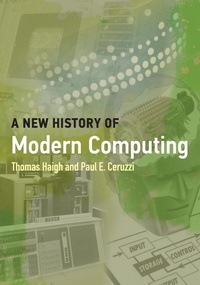
A New History of Modern Computing
Published on 14. September 2021
Book
Paperback/Softback
536 pages
978-0-262-54290-6 (ISBN)
Description
How the computer became universal.
Over the past fifty years, the computer has been transformed from a hulking scientific supertool and data processing workhorse, remote from the experiences of ordinary people, to a diverse family of devices that billions rely on to play games, shop, stream music and movies, communicate, and count their steps. In A New History of Modern Computing, Thomas Haigh and Paul Ceruzzi trace these changes. A comprehensive reimagining of Ceruzzi's A History of Modern Computing, this new volume uses each chapter to recount one such transformation, describing how a particular community of users and producers remade the computer into something new.
Haigh and Ceruzzi ground their accounts of these computing revolutions in the longer and deeper history of computing technology. They begin with the story of the 1945 ENIAC computer, which introduced the vocabulary of "programs" and "programming," and proceed through email, pocket calculators, personal computers, the World Wide Web, videogames, smart phones, and our current world of computers everywhere--in phones, cars, appliances, watches, and more. Finally, they consider the Tesla Model S as an object that simultaneously embodies many strands of computing.
Over the past fifty years, the computer has been transformed from a hulking scientific supertool and data processing workhorse, remote from the experiences of ordinary people, to a diverse family of devices that billions rely on to play games, shop, stream music and movies, communicate, and count their steps. In A New History of Modern Computing, Thomas Haigh and Paul Ceruzzi trace these changes. A comprehensive reimagining of Ceruzzi's A History of Modern Computing, this new volume uses each chapter to recount one such transformation, describing how a particular community of users and producers remade the computer into something new.
Haigh and Ceruzzi ground their accounts of these computing revolutions in the longer and deeper history of computing technology. They begin with the story of the 1945 ENIAC computer, which introduced the vocabulary of "programs" and "programming," and proceed through email, pocket calculators, personal computers, the World Wide Web, videogames, smart phones, and our current world of computers everywhere--in phones, cars, appliances, watches, and more. Finally, they consider the Tesla Model S as an object that simultaneously embodies many strands of computing.
More details
Series
Language
English
Place of publication
Cambridge (Massachusetts)
United States
Publishing group
MIT Press Ltd
Illustrations
88 figures
Dimensions
Height: 251 mm
Width: 177 mm
Thickness: 31 mm
Weight
1116 gr
ISBN-13
978-0-262-54290-6 (9780262542906)
Copyright in bibliographic data and cover images is held by Nielsen Book Services Limited or by the publishers or by their respective licensors: all rights reserved.
Schweitzer Classification
Other editions
Additional editions
Thomas Haigh | Paul E. Ceruzzi
A New History of Modern Computing
E-Book
09/2021
MIT Press
€38.99
Available for download
Persons
Thomas Haigh is Professor of History at the University of Wisconsin-Milwaukee, Comenius Visiting Professor at the University of Siegen, and the coauthor of ENIAC in Action: Making and Remaking the Modern Computer (MIT Press). Paul E. Ceruzzi is Curator Emeritus at the Smithsonian Institution's National Air and Space Museum and the author of Internet Alley: High Technology in Tysons Corner,1945–2005, Computing: A Concise History (both published by the MIT Press), and other books.
Content
Acknowledgments
Becoming Universal: Introducing A New History of Computing
1. Inventing the Computer
2. The Computer Becomes a Scientific Supertool
3. The Computer Becomes a Data Processing Device
4. The Computer Becomes a Real-Time Control System
5. The Computer Becomes an Interactive Tool
6. The Computer Becomes a Communications Platform
7. The Computer Becomes a Personal Plaything
8. The Computer Becomes Office Equipment
9. The Computer Becomes a Graphical Tool
10. The PC Becomes a Minicomputer
11. The Computer Becomes a Universal Media Device
12. The Computer Becomes a Publishing Platform
13. The Computer Becomes a Network
14. The Computer is Everywhere and Nowhere
15. Epilogue: A Tesla in the Valley
Notes
Bibliography
Index
Becoming Universal: Introducing A New History of Computing
1. Inventing the Computer
2. The Computer Becomes a Scientific Supertool
3. The Computer Becomes a Data Processing Device
4. The Computer Becomes a Real-Time Control System
5. The Computer Becomes an Interactive Tool
6. The Computer Becomes a Communications Platform
7. The Computer Becomes a Personal Plaything
8. The Computer Becomes Office Equipment
9. The Computer Becomes a Graphical Tool
10. The PC Becomes a Minicomputer
11. The Computer Becomes a Universal Media Device
12. The Computer Becomes a Publishing Platform
13. The Computer Becomes a Network
14. The Computer is Everywhere and Nowhere
15. Epilogue: A Tesla in the Valley
Notes
Bibliography
Index