

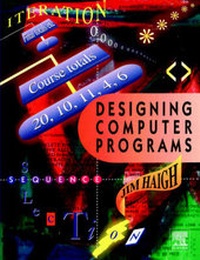
Designing Computer Programs
Published on 6. October 1994
Book
Paperback/Softback
160 pages
978-0-340-61398-6 (ISBN)
Description
This is a book for students at every level who are learning to program for the first time - and for the considerable number who learned how to program but were never taught to structure their programs. The author presents a simple set of guidelines that show the programmer how to design in a manageable structure from the outset. The method is suitable for most languages, and is based on the widely used 'JSP' method, to which the student may easily progress if it is needed at a later stage.
Most language specific texts contain very little if any information on design, whilst books on design approach the topic at too high a level for someone learning their first language. This inexpensive introduction to design can be used alongside whatever programming book suits the student's particular needs.
Most language specific texts contain very little if any information on design, whilst books on design approach the topic at too high a level for someone learning their first language. This inexpensive introduction to design can be used alongside whatever programming book suits the student's particular needs.
More details
Language
English
Place of publication
Oxford
United Kingdom
Publishing group
Elsevier Science & Technology
Target group
Professional and scholarly
All students learning their first computer language as part of an FE or HE course; A level computing; adult education programming courses.
Dimensions
Height: 246 mm
Width: 189 mm
Weight
380 gr
ISBN-13
978-0-340-61398-6 (9780340613986)
Copyright in bibliographic data and cover images is held by Nielsen Book Services Limited or by the publishers or by their respective licensors: all rights reserved.
Schweitzer Classification
Other editions
Additional editions
Jim Haigh
Designing Computer Programs
E-Book
10/1994
Butterworth-Heinemann
€54.95
Available for download
Person
Content
Glossary * Introduction * Structure diagrams * The computer * Repeats of repeats * Menus and subroutines * Arrays * File processing * Validation * Program design language (PDL) * Starting at the top * Answers to exercises * Index.